
I started writing this post a few weeks back at the start of the summer, during the second heatwave of the year. In my office the temperature was reaching thirty-one degrees, my arms sticking to the desk as I worked. Train travel was discouraged, and nearby schools were either closing or moving to half-days. When I added Bananarama’s Cruel Summer to my running playlist at the start of the year little did I know the opening verses would be prophetic.
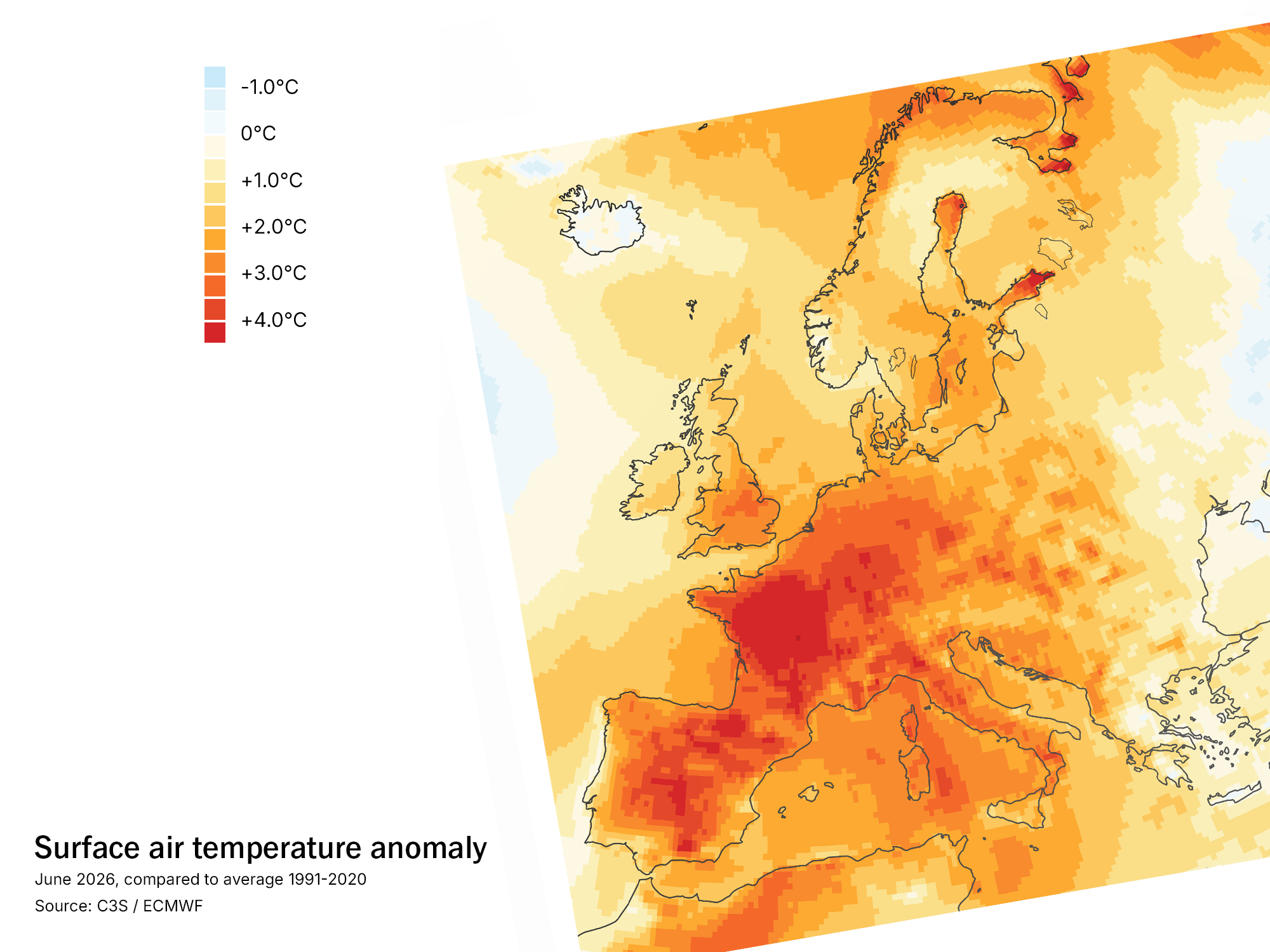
Source: C3S / ECMWF
Now it’s the start of August and we are in the fourth, and records have been falling with unsettling regularity. This is the first year in which temperatures have reached 35°C in three separate months. June was the hottest ever recorded in Western Europe, fuelled by the highest sea surface temperatures ever measured for the month. The heat has occurred alongside exceptional drought, with parts of southern England receiving just 1% of their average July rainfall, and wildfires burning from the Cairngorms to Wales. The ‘green and pleasant land’ is looking decidedly brown at the moment. Across Europe, preliminary estimates suggest the June heatwave alone was associated with around 20,000 excess deaths, with more than 2,700 of those in England and Wales across the May and June heatwaves.
In December I wrote about why UK homes struggle to stay warm in winter. Six months later, the same buildings are struggling in the opposite direction, and for largely the same reason. Once again the problem is the building as much as the weather.
A Climate That No Longer Exists
In May the Climate Change Committee published A Well-Adapted UK, its most comprehensive assessment yet of how the country needs to prepare for the climate impacts already arriving. Its conclusion was blunt: the UK was “built for a climate that no longer exists”. The report identifies extreme heat as the deadliest of the risks we face, warning that by 2050, under 2°C of global warming, 92% of existing homes are likely to overheat, temperatures above 40°C will be possible anywhere in the UK, and heat-related deaths could reach 10,000 a year without action.
Significantly, the Committee now recommends that cooling be rolled out at scale, including air conditioning in hospitals and care homes within the next ten years, and that heat pump subsidies should cover units capable of cooling as well as heating. Just as heating our homes has been the defining comfort challenge of the British winter, cooling them is becoming that of the British summer. But if we simply bolt air conditioning onto housing stock as leaky as ours, we will place enormous demands on an electricity grid already straining to decarbonise, and pay for it in both bills and emissions. The order of operations matters: reduce the heat getting in first, then cool what remains.
Insulation Works Both Ways
Every heatwave seems to come with a familiar comments on social media, often from the States where air conditioning is more prevalent, asking whether Europeans have heard of it. And the equally familiar response, at least from people in Britain, that our houses were designed to keep heat in during winter, and so they trap heat in summer. Ignoring the fact that most British homes are actually really bad at keeping heat in during winter, this exchange rests on a misunderstanding of how a building envelope works.
A well-insulated, airtight envelope reduces the transmission of heat energy through it, in either direction. In winter that means keeping warmth in. In summer it means keeping heat out. Insulation doesn’t care about the time of year, it simply slows the flow of energy from the warm side to the cool side. Around 80% of European homes have no air conditioning, and the housing that copes best in heatwaves tends to be the housing with the best fabric, not the leakiest.
A major issue is solar gain, which acts the same way whatever the time of year. The clue is in the name, as it adds to the thermal energy inside. Sunlight passes through glass as short-wave radiation and is absorbed by the floors, walls, and furniture inside, which warm up and re-radiate that energy as heat. Glass is largely opaque to this re-radiated longer-wave heat, so the energy is trapped inside, warming both the internal surfaces and the air. This is the greenhouse effect operating in your living room. In winter it is a gift, reducing the work the heating has to do. In summer, unmanaged, it is the main driver of overheating.
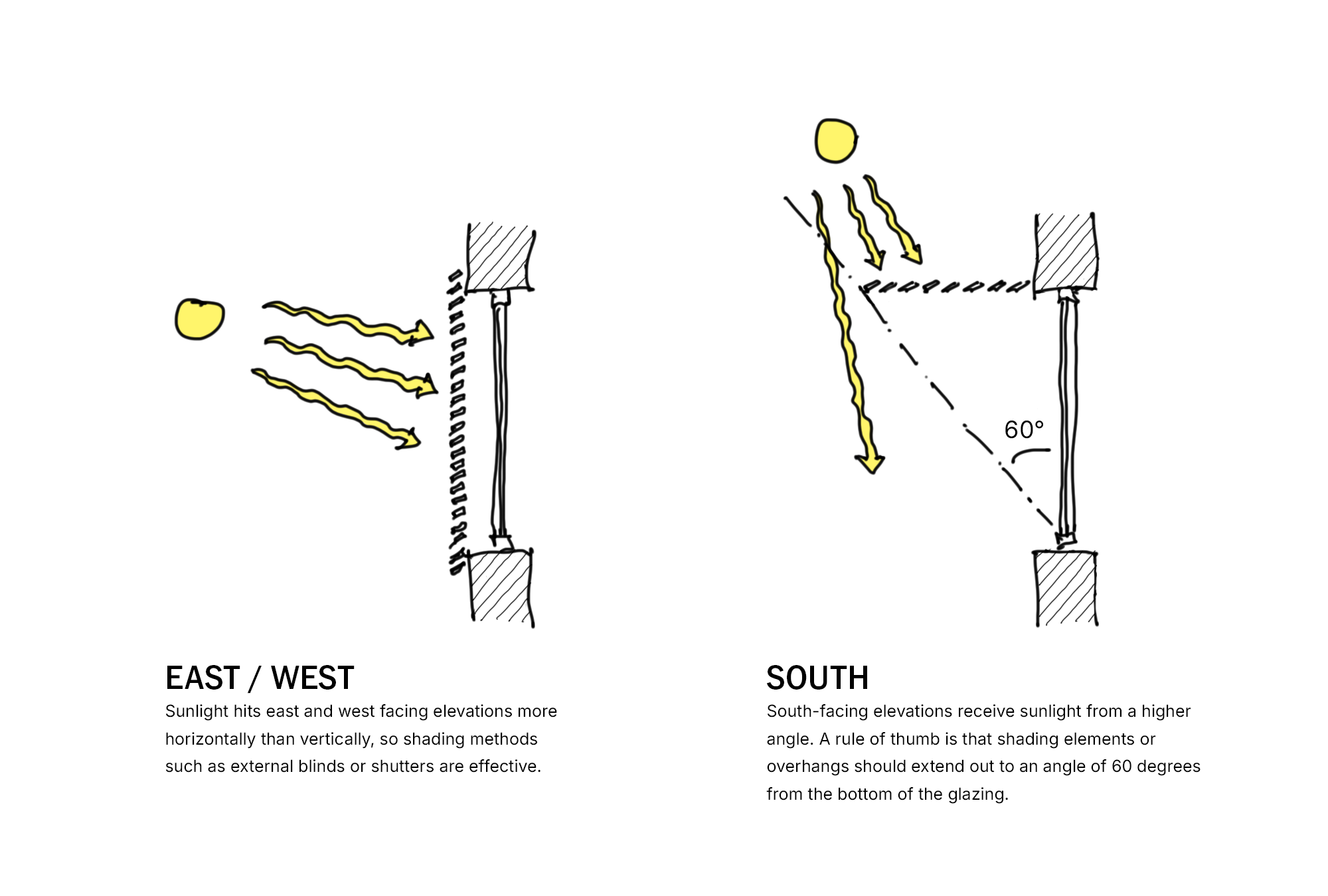
This is where the geometry of shading matters enormously. Once sunlight has passed through the glass, the heat is already inside; an internal blind absorbs the radiation and re-releases it into the room, trapped behind the glazing. Shading fitted externally intercepts the sunlight before it reaches the glass, so the heat is rejected outside where it belongs. The difference is dramatic: external shading can keep out roughly three times as much solar heat as an equivalent internal blind, and a well-designed external system can block 90% or more of solar gain altogether. It is one of the clearest examples in building physics of the same product performing completely differently depending simply on which side of the glass it sits.
Designing for Summer
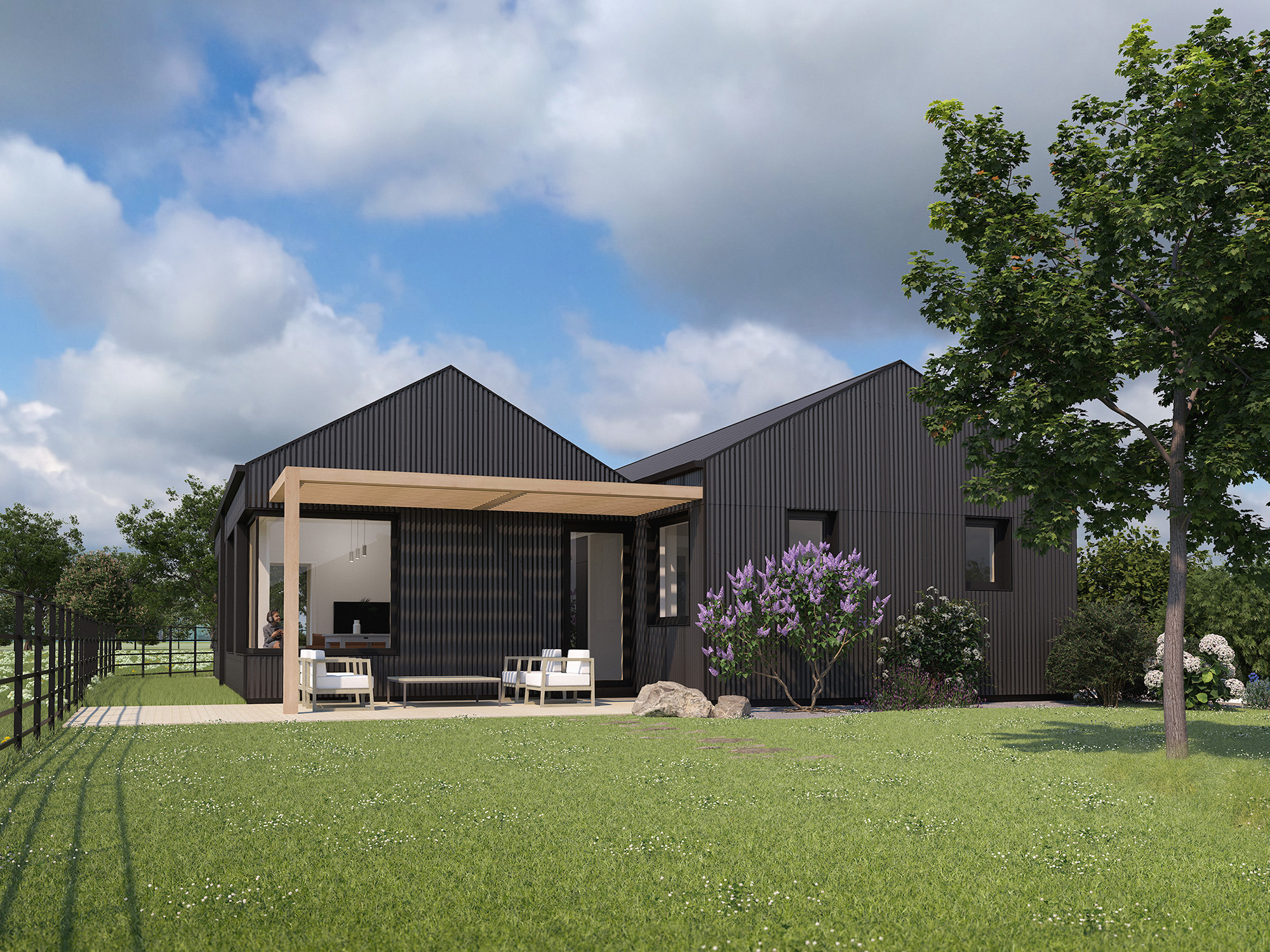
The architectural response to overheating uses the same fabric-first logic as the winter case, with a few additions.
Insulation and airtightness remain the foundation. A high-performance envelope slows the transfer of heat inwards during the day, keeping internal temperatures stable while the outside swings. The same continuous insulation and thermal-bridge-free detailing that keeps a home warm in January keeps it cooler in July.
Built-in shading should be designed in from the start rather than retrofitted in a panic. Brise soleil, deep window reveals, overhangs sized to admit low winter sun while excluding high summer sun, external shutters, awnings, and deciduous planting all do the same job: stopping direct sunlight before it reaches the glass. Traditional architecture across hotter climates has understood this for centuries, from Mediterranean shutters to the deep verandahs of Caribbean vernacular, and it is knowledge we now need to import into British design as standard.
Glazing proportion and orientation deserve honest scrutiny. Large areas of unshaded glass, particularly facing west where low evening sun arrives when the house is already at its warmest, are the single most reliable way to create an overheating problem. The proportion of a facade given over to glass should be a considered design decision, balancing daylight, views, winter solar gain, and summer heat.
Modelling overheating removes the guesswork. In my Passivhaus-informed work I test summer performance in PHPP, which assesses the frequency of hours the house is predicted to exceed 25°C. Passivhaus certification requires this to be below 10% of the year, and good practice aims considerably lower. Running this assessment at design stage means shading, glazing, and ventilation strategies can be adjusted on paper, where changes cost little, rather than discovered as failures in the first hot summer.
A better-performing envelope also transforms the economics of mechanical cooling. With the heat load reduced, a far smaller cooling unit can do the job, and in a very efficient house cooling can even be integrated with the MVHR system, tempering the incoming fresh air. Humidity matters here too: much of summer discomfort is about moisture as well as temperature (part of the issue in June was the high humidity of the air, reducing comfort), and mechanical cooling dehumidifies as it cools, which is a large part of why air-conditioned spaces feel so much more comfortable than the thermometer alone suggests.
Managing the Heat
Alongside the permanent architectural measures, there is plenty that can be done day to day, in any home.
It helps to remember what comfort actually is. As with winter, how hot you feel depends on more than air temperature: the radiant temperature of the surfaces around you, the humidity, and the movement of air across your skin all shape the experience. In winter, good fabric let us feel comfortable at lower air temperatures. In summer the same logic runs in reverse. We can feel perfectly comfortable at higher air temperatures if the surfaces around us stay cool, the humidity is manageable, and the air is moving.
The guiding principle for the air itself is simple: when the air outside is hotter than the air inside, keep the windows closed. Much of the popular advice about creating a through-breeze does more harm than good in the middle of a hot day, because it draws warmer air into the house. The time to open everything up is when the outside temperature drops below the inside temperature, which typically happens at night. This ‘night purging’ flushes the accumulated heat of the day out of the building, and works best when windows are opened at both low and high level, letting the stack effect draw cool air in at the bottom as warm air escapes at the top. It has limits, though. During June’s heatwave, night-time temperatures in places barely fell, and purging achieved little. As tropical nights become more common, we will need to rely on it less.
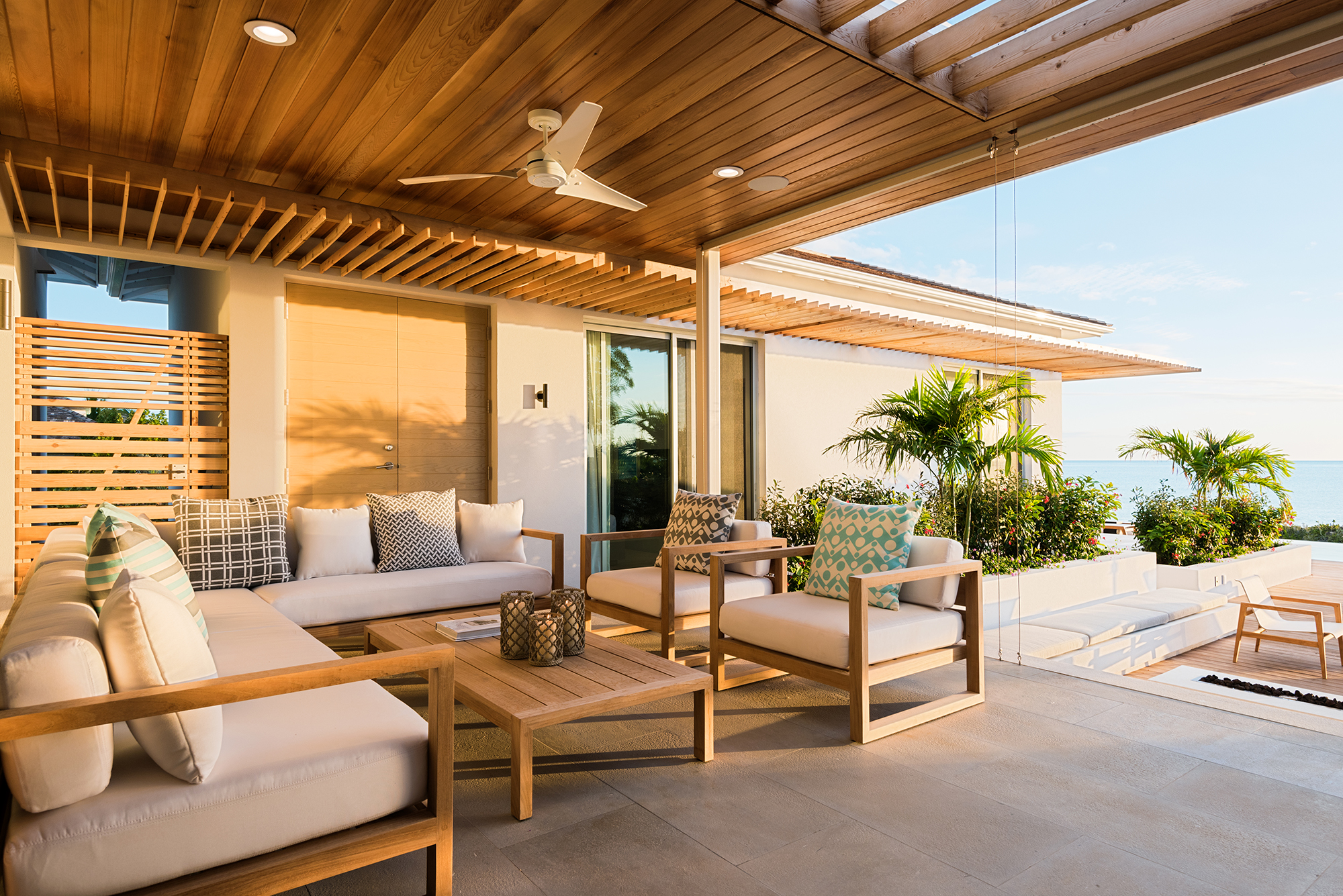
While opening windows is often not advisable to cool the interior during the day, air movement can still play a part in comfort. A fan does nothing to lower the temperature of a room (unless it is directly expelling air to the exterior), but moving air helps the body shed heat through convection and evaporation so the same room feels several degrees cooler. A ceiling fan costs pennies a day to run against pounds for air conditioning, which is why they are ubiquitous in hot climates; every villa I have designed in the Turks and Caicos has them, indoors and out, working alongside deep overhangs rather than instead of them.
When fixed or operable shading isn’t an option due to space, cost, or planning constraints, temporary shading may be possible, and the same physics applies: outside beats inside. Shade sails rigged over south and west-facing glazing, exterior blinds, even a sheet pegged outside a window will outperform any curtain drawn behind the glass. Shaded make temporary awnings that sit on top of sash windows without any fixings, a clever solution for period homes and rented properties where permanent alterations aren’t possible.
The Air Conditioning Question
For a long time, air conditioning in a British home was unnecessary, but unfortunately that era looks to be ending for many. The Climate Change Committee’s recommendation to roll out cooling at scale reflects a reality that other parts of the world deal with: in a hotter climate, cooling serves comfort for most of the summer and becomes a matter of safety at the peaks, particularly for older people, young children, and anyone vulnerable. I suspect that within a decade or two we will regard summer cooling much as we regard winter heating, as a basic expectation of a functioning home.
The concern is how we get there. Air conditioning simply being added to a poorly performing house, with large amounts of unshaded glazing is incredibly inefficient. Multiplied across millions of homes, that means huge electricity demand at exactly the moment the grid is under pressure, higher bills, and higher emissions. The parallel with heat pumps in winter is exact. The technology works, but without improving the fabric first, the unit must be larger, work harder, and cost more, and the underlying discomfort of the building is never really addressed.
Reduce the load first, through insulation, shading, and sensible glazing, and the cooling required becomes smaller, cheaper to run, and genuinely sustainable.
Being Pragmatic
As with winter comfort, this is ultimately about doing what you can with the building, budget, and constraints you have. For a new build or deep retrofit, overheating should be designed out from day one: modelled in PHPP, shaded externally where possible, glazed judiciously. For an existing home, the hierarchy is the same even if the means are more modest: stop the sun hitting the glass, keep the hot air out during the day, purge at night when you can, and if mechanical cooling is needed, size it for a building that has already done the passive work.
It might well be a combination of all three: architecture, management, and air conditioning. There is no purity test here. A home that stays comfortable through a 35°C week, without costing a fortune to run, is a success however it gets there. Every improvement counts, in summer just as in winter.