
How Much Will Your Project Cost?
Perhaps you’ve identified a need for some space, or the current layout doesn’t quite flow right. Perhaps it’s a little too dark in some rooms, too cold, or it takes a tremendous amount to keep warm. Over the Christmas period many of us spent extended periods at home, living through what works and what doesn’t. Perhaps you have a large garden, or a plot of land, and you have designs for something grand. January is when many of us start thinking seriously about improving our homes – but before you can decide whether to extend, renovate, or build new, you need realistic numbers.
How much will it cost? How much is a piece of string? Building projects tend to be unique, and there are a great many variables when it comes to both new houses and renovations to an existing house. But in this post I’ll aim to provide a guide on what home projects cost in East Sussex in 2026.
What Affects the Cost of Your Project?
Three main factors drive costs:
What you’re building. A straightforward extension with a flat roof costs less per square metre than a complex renovation involving structural alterations, underpinning, and working around existing services. New builds offer a blank slate, while extensions need to interface with existing construction. Renovations vary enormously depending on what is there to begin with, what you’re keeping versus replacing.
How you’re building it. Standard construction to current building regulations represents your baseline cost. Higher-performance specifications increase construction costs but dramatically reduce running costs and improve comfort. We’ll look at specific numbers below.
Where you’re building it. East Sussex construction costs sit 7-9% above the national average, reflecting South East labour rates and material transport. Sites with access constraints, steep slopes, or poor ground conditions add further costs. Conservation areas and the South Downs National Park bring additional design and planning requirements that affect both fees and construction budgets.
These three factors interact in complex ways – which is why realistic budgeting usually requires a conversation about your specific site and goals.
Current Market Conditions
Construction costs have stabilised after the volatility in material prices caused by pandemic and Brexit. Timber prices have fallen roughly 30% from their 2022 peak, though they still remain about 40% above 2020 levels. Labour rates continue rising as skilled tradespeople remain in short supply, particularly for quality finishing work.
For 2026 planning, assume modest increases of 3-5% annually. If your project won’t start for 18 months, budget accordingly. A £150,000 project today becomes £156,800 in mid-2027 at 3% annual inflation, or £161,400 at 5%.
Headline Costs: Standard vs High-Performance Construction
For a new home or extension built to current building regulations, you’re looking at £2,000-£3,500 per square metre in East Sussex. But I’d encourage you to think beyond the minimum standards from the start. A fabric-first approach, focusing on the building’s thermal envelope rather than relying on heating systems, adds 15-30% to construction costs but delivers 75-90% reductions in heating demand. That’s not theory, it’s measured performance in completed projects.
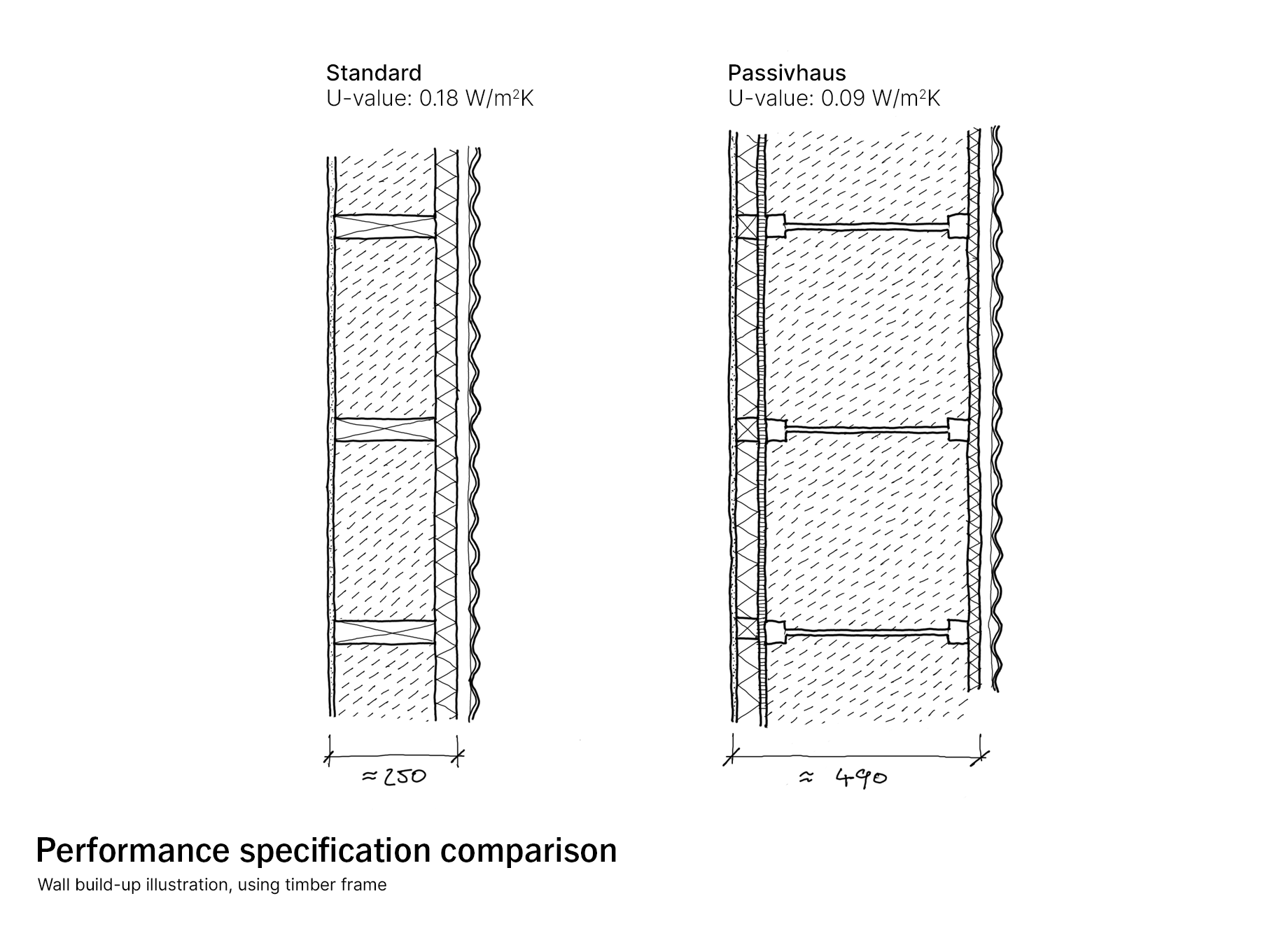
Why mention this now rather than later? Because these decisions shape everything from site orientation to window placement. Trying to add in high performance as an afterthought costs more and achieves less than designing for it from day one.
Standard specification: £2,000-£3,500/m²
High-performance specification: £2,300-£4,500/m²
Renovating existing homes generally costs less per square metre because you’re keeping structure and some finishes: £1,200-£1,800/m² for standard refurbishment. However, upgrading an existing building to high-performance standards (such as EnerPHit) costs proportionally more than new build because you’re working around constraints: £1,700-£3,200/m². The fabric is more complex to improve, and you can’t always achieve optimal orientation or window placement.
The wide spread in figures reflects specification choices – basic finishes at the lower end, premium materials and complex designs at the upper end. Simple forms cost less than complex ones. Two-storey extensions are typically more cost-effective per square metre than single-storey builds because you’re maximizing expensive elements (the foundations, roof, scaffolding) with double the floor area. A renovation requiring extensive structural work sits at the upper end of these ranges.
Fees
Professional consultants (architects, structural engineers, and specialist consultants as required), planning and building control submissions, required reports; these add £10,000-£25,000 for most projects. This isn’t optional cost padding; it’s the expertise that ensures your extension is designed well, approved by the council, and built properly.
Other Significant Costs: Kitchens, Bathrooms, and Professional Services
The construction costs alone don’t give you a complete picture. Projects often involve several other substantial expenses:
Kitchens: £5,000-£25,000+ depending on size, specification, and supplier. A typical 10-12m² kitchen might cost £8,000-£15,000 including units, worktops, appliances, and installation. This covers everything from well-specified high-street ranges through to mid-range bespoke joinery. Higher budgets bring more choice in materials and finishes, but functional, durable kitchens exist across the price spectrum.
Bathrooms: £4,000-£12,000 each for a family bathroom, depending on specification. This includes sanitaryware, tiles, installation, and ventilation. A straightforward bathroom with good-quality fittings typically costs £5,000-£7,000. Ensuites are often smaller and proportionally cheaper; wet rooms or specific accessibility requirements may cost more.
Groundworks and drainage: The headline figures given above include straightforward foundations and drainage connections, but sites with difficult ground conditions or extensive external works may require additional budget.
VAT: Extensions and renovations attract 20% VAT on labour and materials. New self-builds are zero-rated for VAT.
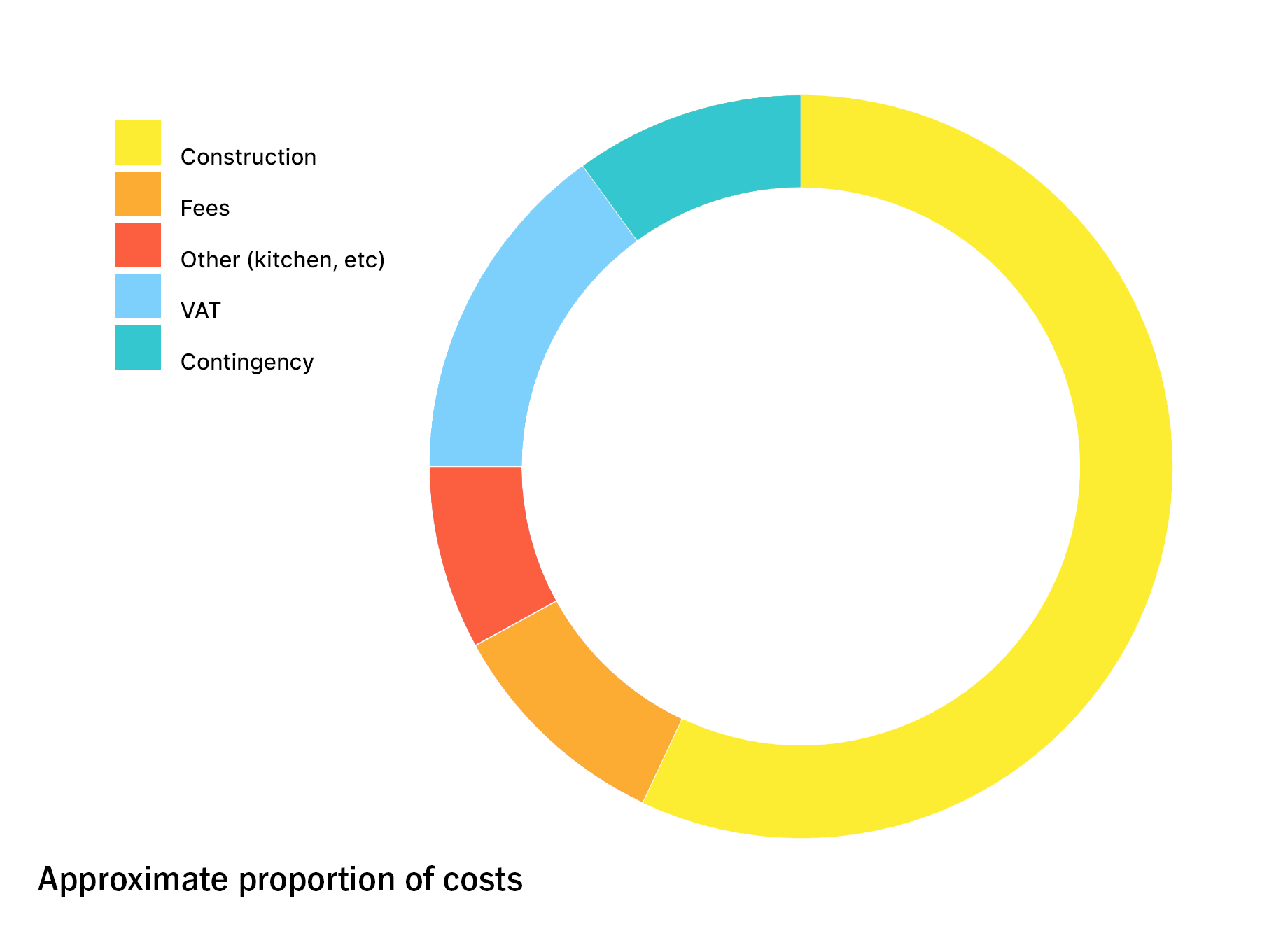
Contingency: Always include 10-15% contingency for unknowns. Ground conditions worse than expected, hidden structural issues in renovations, or material price fluctuations all eat into budgets. Overspending on a projects without a contingency will force you to compromise on quality or go over budget stressfully.
A Worked Example: 25m² Kitchen Extension
For a worked example: a 25m² single-storey kitchen extension at mid-range specification, designed to high-performance standards, might budget as follows:
- Construction: 25m² × £3,400 = £85,000
- Professional fees (15%): £12,750
- Kitchen fit-out: £12,000
- Subtotal: £109,750
- VAT (20%): £21,950
- Contingency (15%): £16,465
- Total budget: approximately £150,000
The same extension to current building regulations would come in around £125,000. The £25,000 difference represents roughly 15 years of reduced energy bills at current prices, plus daily comfort benefits that don’t appear on any spreadsheet.
This isn’t a quote (every project differs) but it illustrates how realistic budgets come together.
Cost Comparison: Standard vs High-Performance Construction
| Project Type | Standard Spec (£/m²) | High-Performance Spec (£/m²) | 25m² Example (Standard) | 25m² Example (High-Performance) |
|---|---|---|---|---|
| New build / extension | £2,000-£3,500 | £2,300-£4,550 | £50,000-£87,500 | £57,500-£113,750 |
| Existing home renovation | £1,200-£1,800 | £1,680-£3,240 (EnerPHit) | £30,000-£45,000 | £42,000-£81,000 |
Figures exclude VAT, professional fees, kitchen, and bathroom fit-out
The premium for high-performance construction isn’t insignificant, but context matters. On a project already requiring £150,000 investment, the additional £30,000-£45,000 for fabric-first design delivers benefits you experience every single day – not just lower bills, but genuine comfort. Consistent temperatures, no cold spots, fresh air without draughts.
Managing Your Budget: Where You Can Save (and Where You Shouldn’t)
Start by questioning the brief: Do you genuinely need more space, or could reorganising what you have solve the problem? Clients who thought they needed a 30m² extension achieved their goals by reconfiguring the existing layout for a fraction of the cost. This isn’t me talking myself out of work, it’s making sure you invest wisely.
Build in phases if necessary: If your budget is tight, prioritise on getting the building fabric right: the structure, insulation, airtightness, and windows. While it’s desirable to have everything perfect from day one, you can upgrade kitchen units, sanitaryware, and finishes later. What you can’t easily change is the thermal performance or structural decisions.
Where not to scrimp:
- Building fabric performance (changing insulation levels later is prohibitively expensive)
- Structural work (getting it wrong means remedial costs far exceed initial savings)
- Waterproofing and damp-proofing (problems manifest slowly but cost enormously to fix)
- Professional fees (poor design costs more to build, and mistakes are expensive to correct)
Where you have flexibility:
- Kitchen and bathroom specifications (upgrade fittings later without affecting the building)
- Internal finishes (paint-grade joinery now, upgrade to hardwood later)
- Landscaping (tackle this once building work settles)
- Some mechanical systems (start with basics, add sophistication as budget allows)
For renovations specifically, working room-by-room or element-by-element makes projects more manageable financially. You might tackle the thermal envelope first year, services second year, finishes third year. This phased approach works if you can live with disruption and don’t need everything immediately.
What This Means for Your Project
These figures should help you assess whether your project ideas align with your budget, or whether you need to adjust scope, specification, or timeline. If you’re working with numbers significantly lower than these ranges, it’s worth questioning what quality you’ll actually achieve. If your budget is comfortable within these ranges, focus on getting the design right rather than value-engineering down to minimum standards.
If your house felt cramped over Christmas, or cold despite the heating running, or dark during the shortest days – those observations are worth acting on. And if you’re going to invest in improving your home, it’s worth doing it properly. Not just meeting minimum standards, but creating a home that works beautifully and costs less to run.
If you’d like to discuss a specific project and what realistic budgets might look like for your situation, get in touch. An initial consultation helps establish whether your aspirations, site, and budget can work together – or what adjustments might be needed to make them work.