

Growing up, I remember visiting my nan and grandad’s council house in Essex. In winter the living room was roasting – you’d sit as close to the coal fire as you could bear, face flushed with heat. But step into the hallway and the temperature dropped noticeably. There was heating in the other rooms, but they were kept cooler, or at least that’s how it felt to me as a child. And the outdoor toilet (there were two, one inside upstairs, one outside) was genuinely freezing in winter.
This was how many of us grew up understanding heating: one room kept intensely warm, the rest of the house cooler, and comfort measured by proximity to a heat source.
Apart from a brief cold snap, it’s been a fairly mild winter so far. But as temperatures drop over the coming weeks millions of people will reach for the thermostat in search of comfort – and find their energy bills rising while the chill persists. The problem isn’t usually the heating system, it’s the building itself.
The UK’s Leaky Housing Stock
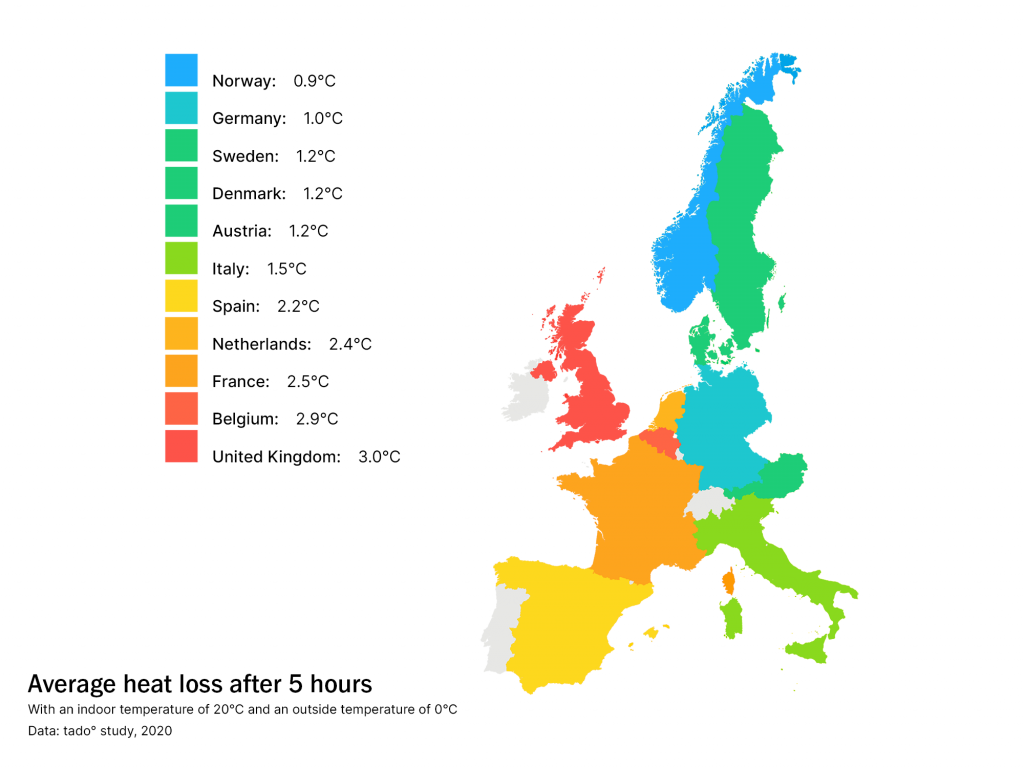
Housing in the UK is notably leakier than much of mainland Europe. Typical UK homes lose heat up to three times faster than comparable homes in Germany and Norway, and despite our relatively mild climate we use slightly more energy than the EU average. The main drivers are older housing stock, weaker historic building standards, and slower retrofitting rates.
The recent surge in energy costs, driven by global gas price shocks following Covid and Russia’s invasion of Ukraine, has made this leakiness painfully expensive. With approximately 85% of UK households still using gas for heating, and electricity prices linked to wholesale gas, almost everyone has felt the impact. Fuel poverty – officially defined as living in an inefficient home (EPC rating D or below) while energy costs push household income below the poverty line – affects an estimated 6 million UK households.
With 80% of the buildings that will exist in 2050 already standing today, millions desperately need upgrading, not just to reduce carbon emissions, but to provide genuine comfort to their inhabitants.
The Fabric-First Approach
The ‘fabric-first’ approach (as advocated by bodies such as the Passivhaus Institute, the BRE, and LETI among others) prioritises the building envelope itself – the external walls, ground floor, roof, windows and doors. Get this right, and you need far less energy to stay comfortable.
Insulation forms the foundation. To achieve genuine thermal comfort with consistent temperatures throughout, and no cold spots, far more insulation is needed than current building regulations require. The exact amount varies depending on location, orientation, and glazing area, but for Passivhaus-level performance in the UK, it typically means approximately twice the regulatory minimum. Crucially, this insulation must be continuous, with as few thermal bridges as possible (ideally none). A thermal bridge is any material path between interior and exterior without an insulating break: think of a steel beam passing through the wall, conducting heat straight outside.
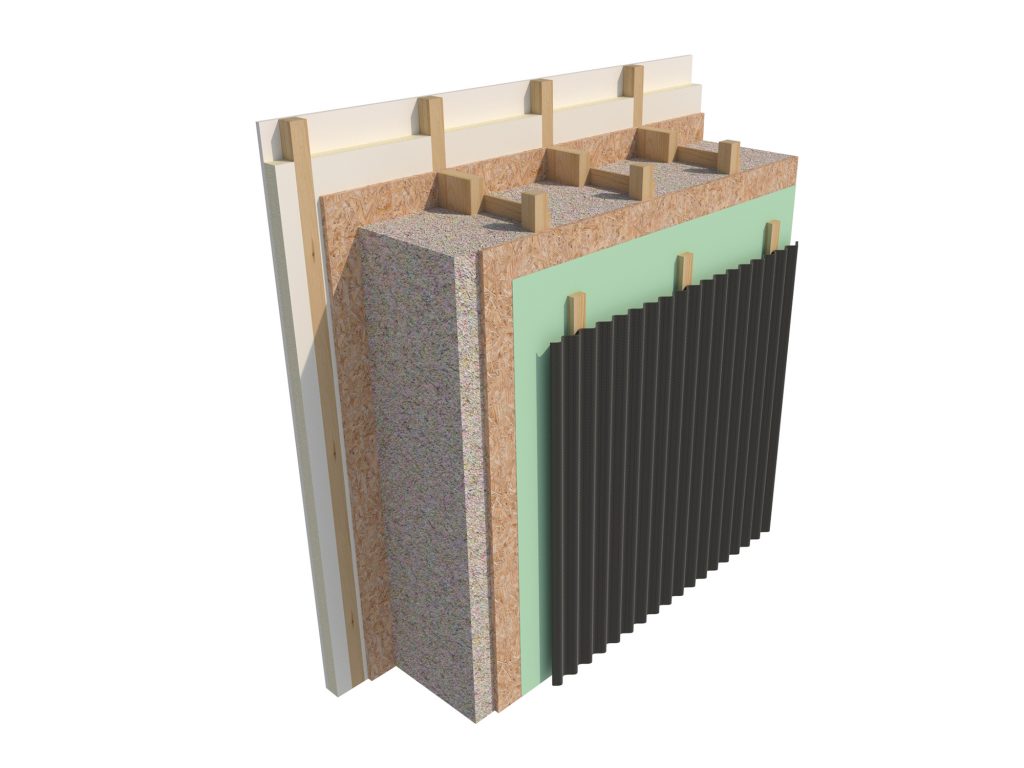
For existing homes, retrofitting can be disruptive, and poorly-managed government schemes haven’t helped public confidence. A practical approach is to tackle improvements room by room, or prioritise the elements with greatest impact: typically loft insulation first, then walls, then floors. Even partial improvements make a measurable difference to comfort and running costs.
Airtightness measures how leaky a building is (not to be confused with ventilation, which is about controlled fresh air supply). Current building regulations set a maximum air permeability of 8 m³/hr/m² – roughly equivalent to a 20p-coin-sized hole in every square metre of building envelope. Passivhaus, by contrast, requires less than a 5p-coin-sized hole per 5 square metres – around 10 to 15 times more airtight.
With such tight construction, mechanical ventilation with heat recovery (MVHR) supplies fresh air while retaining up to 95% of the warmth from outgoing air. The heated air you’ve paid for isn’t sacrificed every time you need fresh air, as happens when you simply open a window.
Solar gain, the sun’s contribution to internal temperature, can be optimised through careful design: welcomed in winter through south-facing glazing, controlled in summer through shading to prevent overheating.
The Physics of Comfort
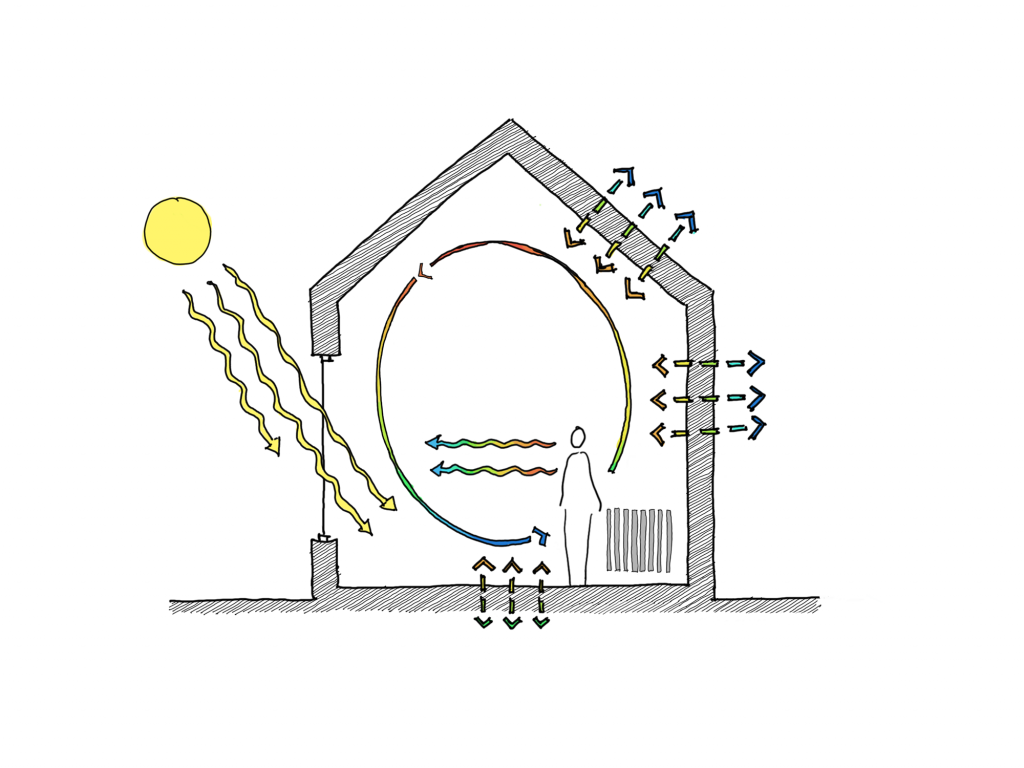
Understanding why these measures work helps explain why fabric matters more than heating output.
Conduction is heat flowing through solid materials, from the warm side to the cool side. Your insulation fights this: slowing the flow of heat through walls, roof, and floor to the cold outdoors.
Convection is heat transfer through air movement. Airtightness reduces heat escaping with outgoing air, but internal draughts also affect comfort significantly. I remember standing up after sitting in my parents’ living room and feeling noticeably warmer – the upper half of the room was several degrees higher than where I’d been sitting. Warm air rising from radiators, cold air sinking from poorly-sealed windows, convection currents across large glazed areas – all can make a room feel uncomfortable even when the thermostat reads a perfectly reasonable temperature.
Radiation is heat transfer through electromagnetic waves, no air or contact required. The warmth you feel from sunshine, a radiator, or a wood stove is radiant heat. Equally, a large cold window surface draws heat from your body. Comfort depends heavily on the temperature of surrounding surfaces, which is why designing for warmer internal surfaces through good insulation and careful glazing design allows a room to feel comfortable at a lower air temperature.
This is why triple glazing matters: the interior face of the glass stays above 17°C even in cold weather (as a rule of thumb, with 21°C internal temperature and 0°C outside), eliminating that uncomfortable radiative chill from large windows.
The result: consistent temperatures, no draughts, warm internal surfaces. Comfort achieved at lower air temperatures, requiring less energy. This is the purpose of fabric-first design, and why it matters more than the heating system itself.
The Embodied Energy Question
With the climate emergency, both the total carbon emissions of a building and the timing of those emissions over its life really matter. Energy efficiency is not the only consideration. Embodied carbon (the emissions from manufacturing and constructing the building) can account for a large share of its lifetime impact. Adding more insulation to reduce heat loss means using more material, each with its own carbon cost. Because emissions must fall rapidly, this tension calls for thoughtful design, not simply thicker walls.
The answer lies in material selection (natural insulation materials like wood fibre or hemp have lower embodied carbon than synthetic alternatives), appropriate specification (enough insulation to achieve comfort, not arbitrary excess), and longevity (buildings designed to last reduce the frequency of carbon-intensive replacement).
But What About Heat Pumps?
Some argue that fabric improvements aren’t essential, that heat pumps, increasingly popular thanks to government grants, can keep homes warm while reducing costs and emissions without disruptive building work. Most buildings can accommodate heat pump installation.
There’s a legitimate point here about urgency. With millions of homes needing to decarbonise rapidly, waiting for comprehensive fabric upgrades before switching heating systems could slow progress unacceptably. A heat pump installed today starts cutting emissions immediately, even if the building envelope isn’t perfect.
But there are trade-offs. Without a better-performing envelope, the heat pump needed will be larger, using more energy and running less efficiently. As the national grid electrifies with heat pumps, electric vehicles, and other demands, reducing each property’s energy requirement becomes essential to ensuring supply meets demand.
More importantly for occupants: without a better envelope, you get reduced emissions and lower bills, but not necessarily improved comfort. The draughts remain. The cold spots persist. Fabric-first design addresses the experience of living in a building, not just its carbon footprint.
Finding the Right Balance

Photo by Jerry Zheng on Unsplash
Of course, fabric-first design doesn’t exist in isolation. Every project must balance budget, available space, programme, and context, including what views to celebrate and whether planning constraints apply.
The key is setting realistic performance targets early. Passivhaus certification is the gold standard for building performance, but it isn’t achievable for every project, and that’s fine. EnerPHit offers a rigorous standard for retrofit projects. CarbonLite standards sit between Passivhaus and current building regulations. Even improvements that fall short of any formal standard make a real difference to comfort and running costs.
What matters is understanding your constraints from the outset, setting appropriate targets, and delivering them well. A project that achieves exactly what it set out to achieve, with a warm, comfortable, efficient home at the end, is a success whatever standard it meets. The alternative, chasing an unrealistic target and feeling like you’ve compromised, benefits no one.
Every improvement counts. A home that’s warmer, more comfortable, and cheaper to heat than it was before is a home worth building.