
As a child, I loved Disney’s Swiss Family Robinson, a film released in 1960 based on the novel of the same name about a family of Swiss immigrants shipwrecked on a tropical island. To create shelter and safety, the family construct an elaborate treehouse from salvaged materials complete with a water wheel, a pulley-operated lift, and rooms branching through multiple trees. What captivated me was how it felt like a living system: rooms distributed across separate trees and connected by bridges, the whole structure animated by pulleys and water power. It was shelter that had become part machine, lightweight by necessity, ingenious by nature.
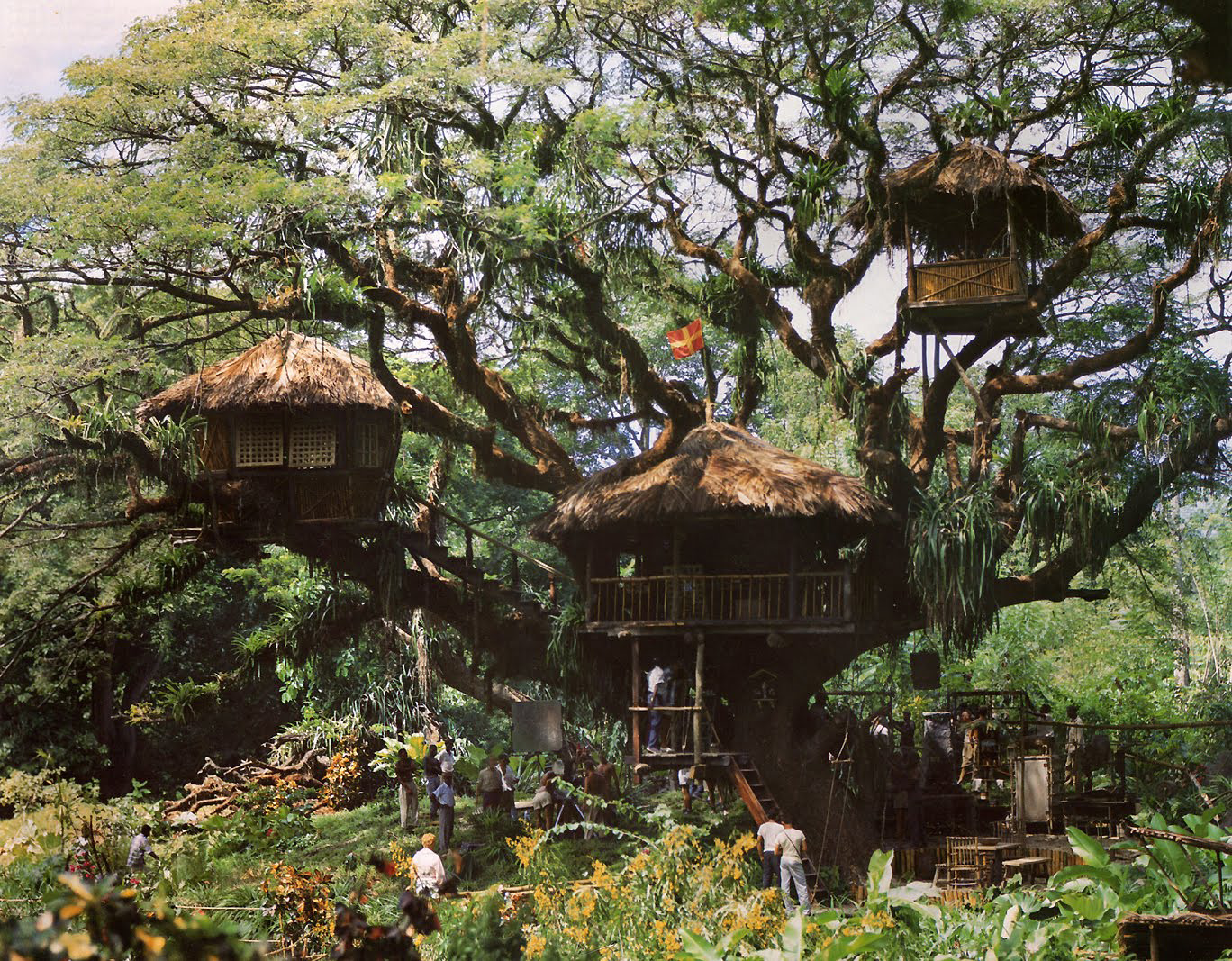
Similarly, high up in the trees of the forest moon of Endor, the Ewoks from Return of the Jedi built their village: an interconnected community of huts linked by rope bridges and wooden walkways, camouflaged within the canopy rather than imposed upon it. It wasn’t a single treehouse but a whole settlement, each platform leading to another, the architecture dissolving into the forest.
But these were just films. What made them stick was that I had somewhere to imagine them. The town where I grew up in Hampshire was surrounded by woods, and I spent hours in them: walking with my family, playing with friends, learning what it felt like to be enclosed by trees. Woods felt like home. They still do.
These childhood inspirations planted something that, decades later, I recognise as an architectural calling. I want to design a treehouse. Not as novelty projects or garden follies, but as serious pieces of architecture that happen to exist among the branches.
Why Treehouses Matter to Architecture
Every treehouse is an exercise in constraint. You cannot simply pour foundations and erect walls. You must negotiate with a living structure, understanding its growth patterns, its seasonal movements, its tolerance for load. Architecture as dialogue, not monologue. This forces a kind of architectural humility that improves everything else you design.
A treehouse demands lightness. Every kilogram matters when you’re suspended above the ground. This pushes you toward elegant solutions: efficient structures, minimal material, maximum effect. These lessons transfer directly to sustainable design, where reducing material use is an environmental imperative.
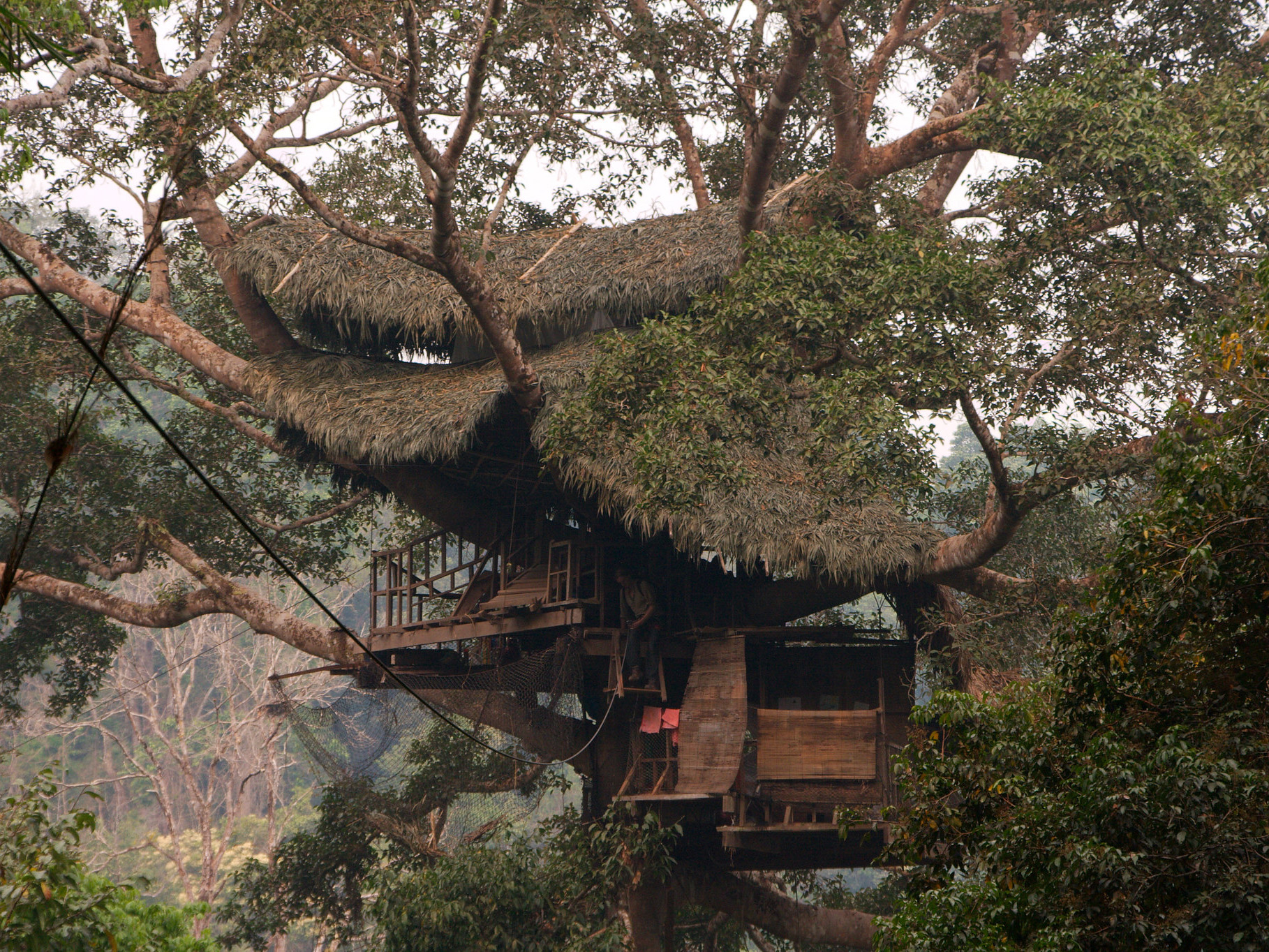
There’s something inherently playful about architecture that requires a ladder, that asks you to climb before you can enter. But playful doesn’t mean frivolous. Play is how we test boundaries, how we experiment, how children learn and adults remember how to learn. A building that invites play is a building that invites engagement. That’s not a lesser architectural ambition; it’s a higher one. No one climbs to an elevated platform and feels nothing. The architecture must answer that feeling with spaces worthy of the journey.
The Technical Challenges
Treehouse construction splits broadly into two approaches: buildings supported by the trees themselves, and buildings elevated on independent structures that happen to exist among trees (and of course a combination of the two).
For tree-supported structures, tree attachment bolts, commonly known as TABs, have transformed what’s possible. These engineered fixings allow substantial loads to be carried by living trees while minimising damage. A single properly installed TAB can support several tonnes. Combined with knee braces and carefully designed load paths, they enable buildings that genuinely live with their host trees.
Cables can be hung, suspending the structure much like portaledges from the climbing world. There’s something compelling about this approach beyond mere practicality. Most buildings work in compression: heavy materials bearing down, weight transferred to solid ground. Tension structures invert this logic. They hang, stretch, hold themselves aloft through forces we can’t quite see. It’s a slightly alien way of building, which is part of what intrigues me. And ecologically, every kilogram not used is a kilogram not extracted, transported, processed. Lightness isn’t just elegant; it’s responsible. This is a place where sky hooks, long a joke by Structural Engineers, are actually possible.
For independent structures, slim steel columns or carefully placed timber posts can raise platforms to canopy height while roots remain undisturbed below. The best examples make virtue of this: posts that echo the vertical rhythm of surrounding trunks, structures that seem to have grown alongside the forest rather than been inserted into it.
Both approaches must address the same fundamental challenges: how does the building accommodate tree movement in wind? How does it handle seasonal swelling and shrinkage? How do you create thermal performance with minimal bulk? How do you manage moisture in a forest environment?
How do you arrive? The difference between ground and platform becomes a fundamental design problem. Every treehouse demands a threshold: the moment when you leave solid earth and begin to climb. This isn’t a transition to rush. The best arrivals choreograph the journey, whether by ladder, rope bridge, or spiral stair winding around a trunk. By the time you reach the platform, you’ve earned it. You’ve left something behind. You’re among the branches now, elevated above the familiar, surrounded by air where walls would normally be. Whatever brought you here can wait until you climb back down.
What Excellence Looks Like
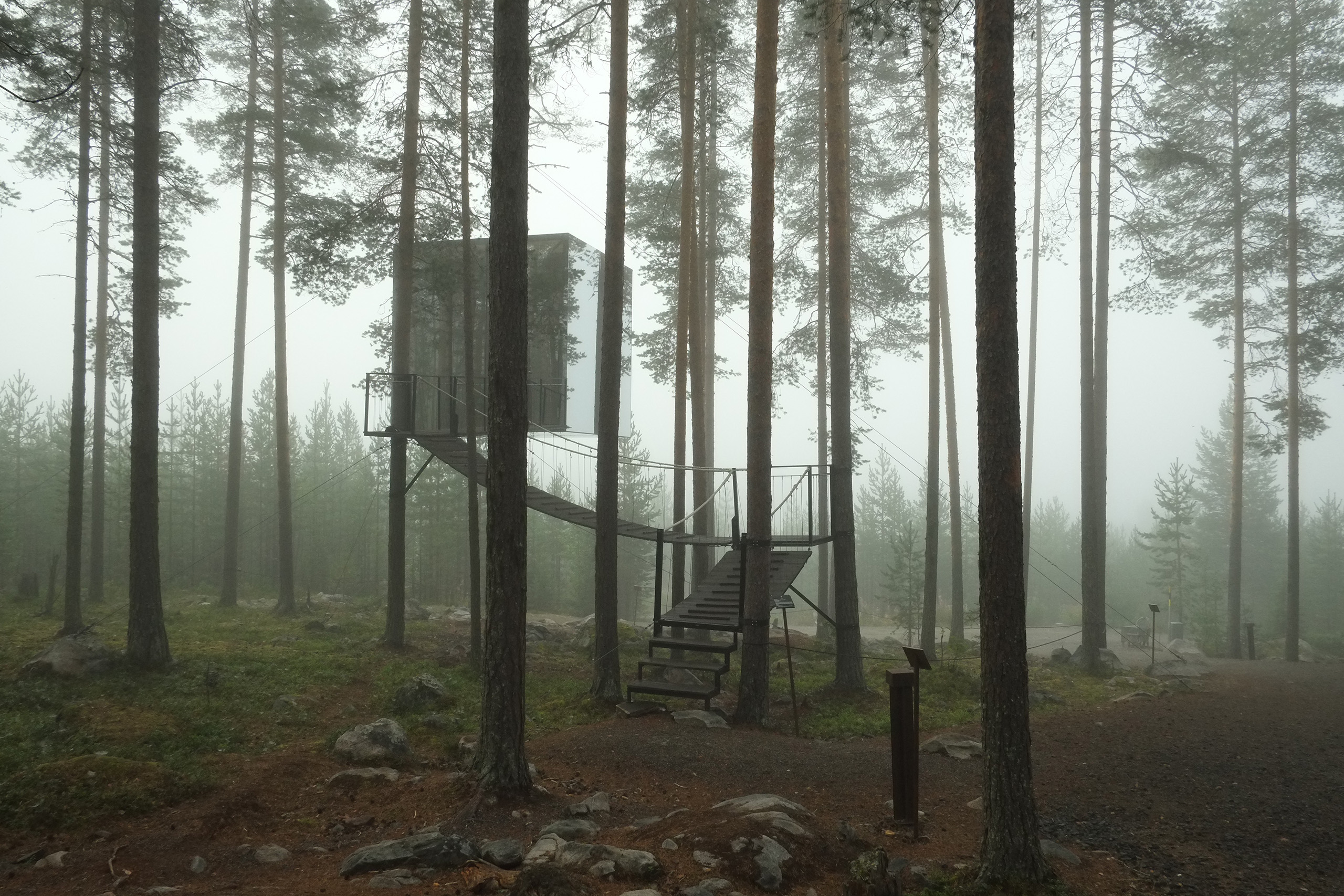
The Treehotel in northern Sweden demonstrates range. Tham & Videgård’s Mirrorcube wraps itself in mirrors that reflect the surrounding forest, creating a disappearing act among the pines. Snøhetta’s 7th Room takes the opposite approach: a dark-timbered cabin ten metres above the ground, supported by slender posts that echo the vertical rhythm of the surrounding pines. A netted terrace extends into the branches, allowing guests to lie suspended among the canopy looking up at the Northern Lights.
The Dursley Treehouse by Millar + Howard Workshop proves that elevated architecture can achieve genuine thermal performance. Passivhaus certified, it demonstrates that “up in the trees” needn’t mean “draughty and cold.” This matters enormously: it shows that the lightness treehouse construction demands doesn’t preclude serious environmental performance.
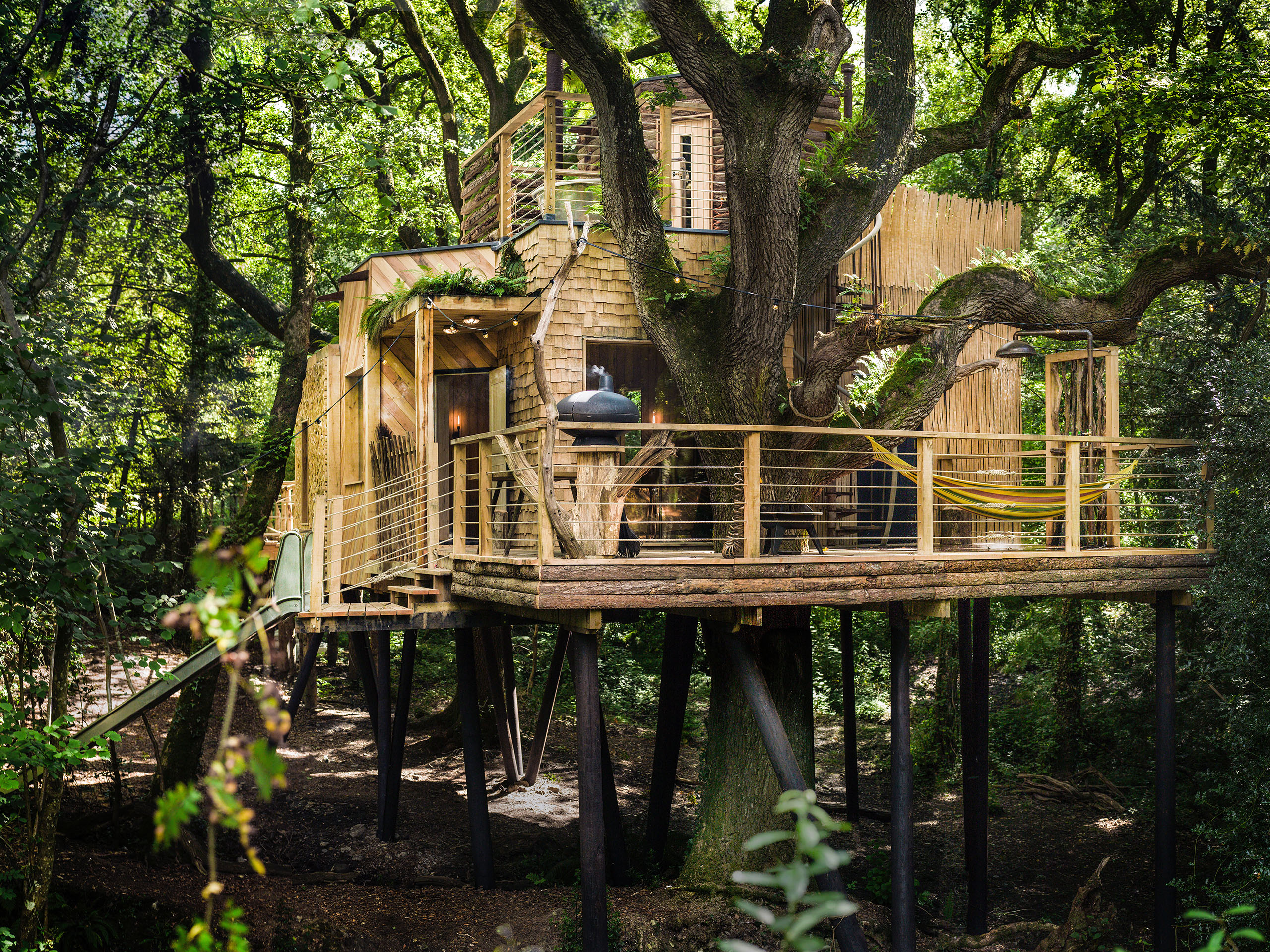
The Woodsman’s Treehouse in Dorset, designed by Guy Mallinson with BEAM Architects, won a RIBA award and attracted international attention. The rope bridge approach, the slide, and the careful integration of modern amenities with rustic materials show how treehouses can be both whimsical and sophisticated.
A Japanese Lesson
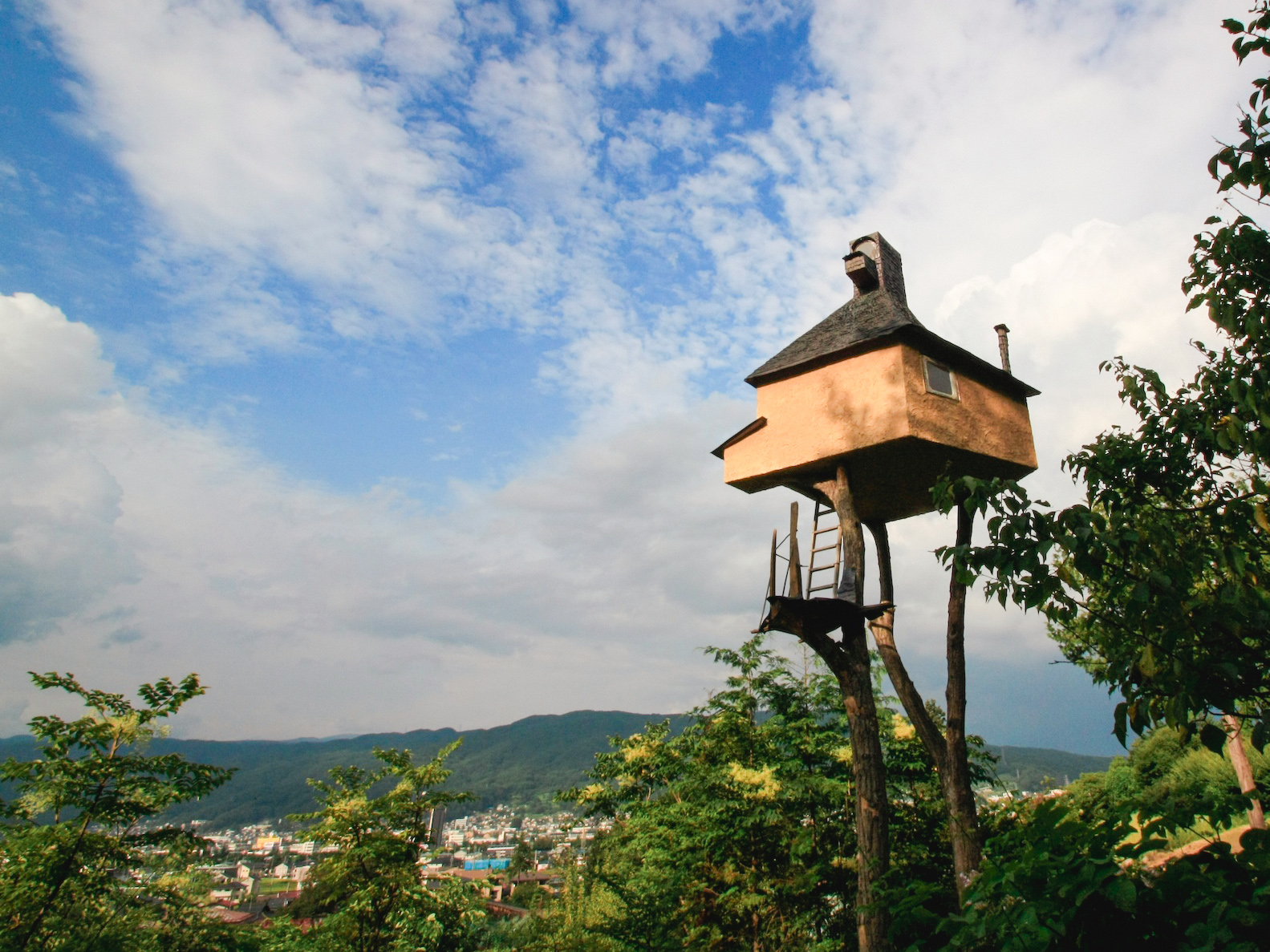
The architect Terunobu Fujimori builds treehouses in Japan that look like they’ve emerged from fairy tales, yet are grounded in profound understanding of materials and craft. His Takasugi-an, the “too-high tea house,” perches on two chestnut tree trunks, accessed by freestanding ladders. It’s deliberately absurd, yet deeply serious about the Japanese tradition of the tea ceremony and its separation from the everyday world.
Fujimori’s work reminds us that treehouses connect to something ancient: the human desire to be elevated, to see further, to escape the ordinary ground. Past and present, ground and sky, held in a single glance. Every culture has stories about people who lived in trees. The architecture is catching up to the mythology.
Why This Matters for My Practice
Mountain Fold Architecture is built on the principle that buildings should be “inevitable to their place”: architecture that could exist nowhere else, shaped by site, climate, and local tradition. A treehouse is perhaps the ultimate test of this principle. It must respond not just to a location but to specific trees, their particular branching patterns, their individual structural capacities.
The principles I pursue in every project – minimal material, maximum performance, working with natural systems – find their most concentrated expression in treehouse construction. Thermal performance through intelligent design rather than brute material, foundations that touch the earth lightly, buildings that respond to their sites: these challenges aren’t new to me, but a treehouse would intensify them.
The Dream That Remains
I haven’t yet had the right project. But the thinking has been underway for years. I’ve walked woodland sites in Sussex and Hampshire, calculating sight lines, feeling wind patterns, reading the spaces formed between branches. The skills transfer: lightweight construction, minimal foundations, buildings that respond to living systems, thermal performance through intelligent design rather than brute material. These aren’t treehouse-specific challenges. They’re the challenges of sustainable architecture, concentrated and clarified. When the right woodland site and the right client come together, I’ll be ready.
It would need to sit lightly, to touch the forest as gently as possible. It would need to frame the particular views that only that location provides. It would need to perform thermally without relying on bulk, to manage moisture and ventilation in ways that work with the forest environment rather than against it.
And it would need that quality I remember from the Hampshire woods: the sense that you’ve found shelter not by conquering the landscape but by learning to belong within it. The forest offering a place to rest. If you have a woodland site and a similar dream, I’d love to hear from you. I’ve been waiting since childhood, and I think the Ewoks had the right idea all along.