
This is the second part of my exploration of South Downs materials. In Part 1, I examined the geological origins of chalk and flint and explored how contemporary architects are using flint as sophisticated cladding. Here I turn to chalk’s remarkable revival as structural material and what these ancient techniques mean for contemporary projects in the South Downs.

Original image by Les Chatfield from Brighton, England, CC BY 2.0, Link, via Wikimedia Commons
When excavation begins on a building site in the South Downs, tonnes of chalk rubble emerge from the ground. Standard practice: crush it and use it as a sub-base for paths, or load it into skips, pay for removal, then import concrete and brick from elsewhere. But what if that excavated chalk could become the building itself?
While flint has maintained a continuous tradition as cladding, using chalk as a structural material nearly disappeared from British building. It was perceived as too soft, too weak, too vulnerable to weather. Chalk blocks were occasionally used in sheltered locations, and chalk rubble served in foundations, but as a primary building material, chalk seemed to belong to a pre-industrial past. Other materials were more durable, needing fewer additional measures to protect them.
The rejection of chalk paralleled the rejection of lime. Portland cement, developed in the 1840s, created mortars and renders that set harder and faster than lime. But it lacks lime’s flexibility and breathability. Cement-based render can trap in moisture, leading to damp problems and increased deterioration in other materials. Lime mortar works with moisture rather than fighting it, flexing with seasonal movement rather than cracking, and supporting natural insulation materials like wood-fibre board.
But what if chalk itself could be the structure, not just the source of lime? Recent projects prove that rammed chalk construction can meet modern requirements while offering distinct environmental advantages: minimal embodied carbon, natural thermal mass, and the circular economy of building with excavated material from your own site.
Rammed Chalk: Structure from the Soil Beneath
Rammed chalk construction follows principles similar to rammed earth but with specific characteristics derived from chalk’s distinct properties. The technique offers a remarkable circular economy opportunity: when building on chalk, excavation for foundations produces the building material itself. What might be “waste” spoil becomes structure.
The Construction Process
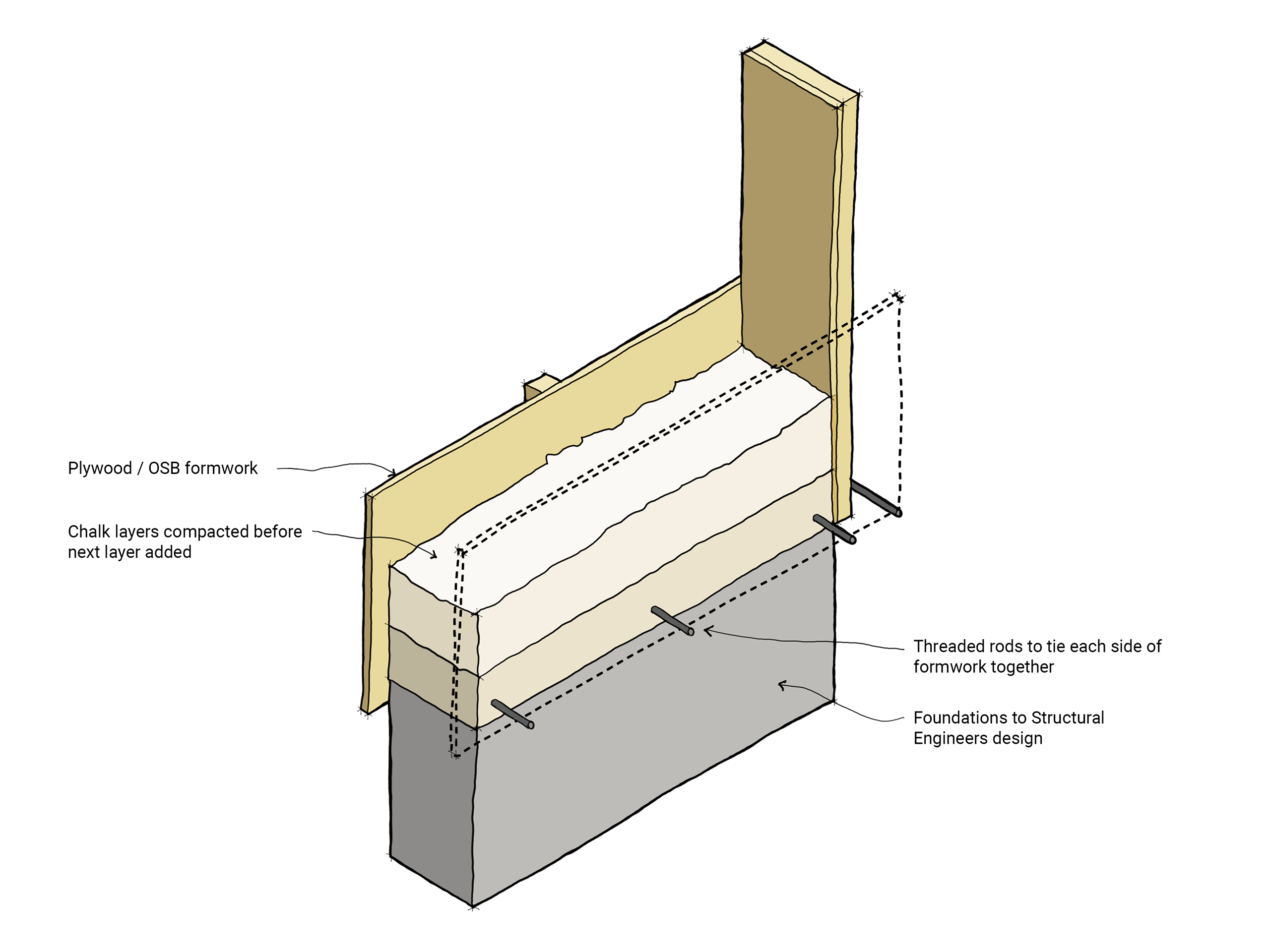
The process begins with excavation. The chalk rubble is crushed into fragments no bigger than 50-75mm – small enough to compact well but large enough to create strength through interlocking. This crushed chalk is often then mixed with a small amount of hydrated lime or clay, which acts as a stabiliser and binder, helping the material cohere as it cures.
Moisture content must be carefully controlled – too wet and the mixture won’t compact properly, too dry and it won’t bind. Getting this balance right requires experience and attention to local chalk characteristics, as different chalk formations have slightly different properties.
The mixture is then placed in formwork in layers (called “lifts”) of around 100-150mm depth. Each lift is compacted using pneumatic rammers or, on smaller projects, manual tamping. The compaction is crucial: it drives out air pockets, increases density, and creates the material’s strength. As each lift is compacted, the chalk particles interlock while the lime begins its slow carbonation process, gradually hardening over months as it reacts with carbon dioxide from the air.
The formwork – typically timber panels tied together with removable bolts – must be substantial enough to resist the considerable lateral pressure of ramming. As each section is completed and has achieved sufficient strength, the formwork is stripped and reused for the next section. This reusability of formwork is essential for both economy and sustainability.
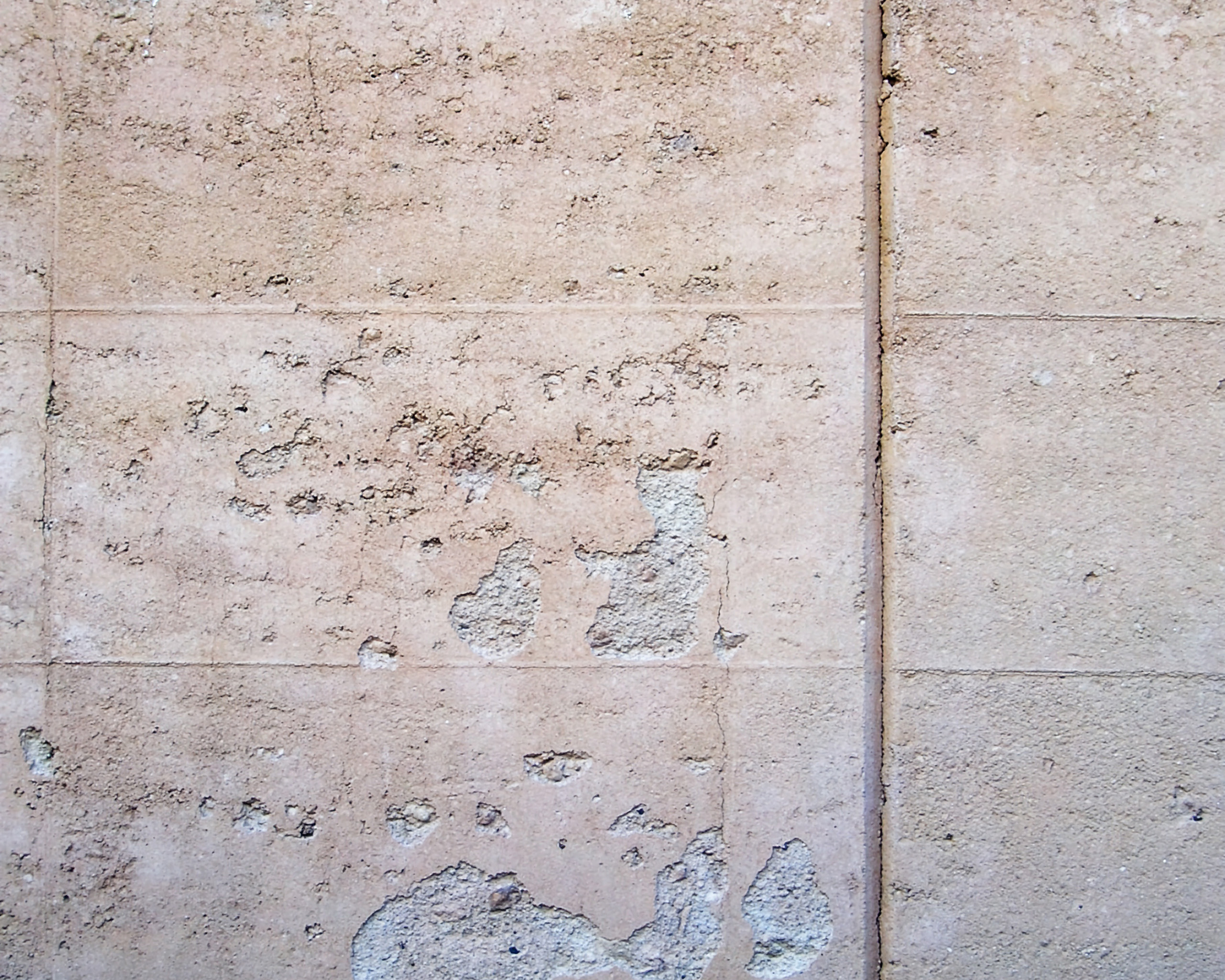
Like rammed earth, exposed chalk walls show beautiful stratification, each lift creating subtle horizontal lines that reveal the construction process – an honest expression of how the building was made. The colour varies depending on the local chalk: creamy white in Dorset, warmer tones where iron oxide is present. The surface can be left raw, lime-washed to prevent dusting, or finished with lime render where required. Unlike cement render which traps moisture, lime allows the wall to breathe, managing seasonal moisture movements naturally.
Chalk House: Proving the Technique
Barefoot Architects demonstrated that rammed chalk could meet modern structural requirements with their founding project, Chalk House in Dorset. The site sits in view of Maiden Castle, an Iron Age hill fort constructed entirely of chalk ramparts. That ancient precedent, visible on the horizon, provided both inspiration and cultural permission for radical material thinking. Planning requirements demanded the house be partially buried into the site to reduce visual impact. Rather than dispose of excavated chalk as waste and import building materials, it was instead used to create thick perimeter walls providing structure and thermal mass.
These massive walls moderate internal temperature, slowly absorbing heat during the day and releasing it at night – passive environmental control built into the material itself. A glulam timber frame carries the upper level, while all the timber formwork used for ramming the chalk was later reused as floor, roof, and internal wall construction. This zero-waste approach epitomises circular design thinking.
The approach closed multiple loops: excavation became construction, waste became resource, embodied carbon dropped dramatically below conventional building. The house demonstrates that intelligent material use can reduce environmental impact while creating exceptional architectural quality.
UK Precedents and Current Revival
© Andrew Dunn, CC BY-SA 2.0, Link
Chalk House isn’t without precedent, though examples are rare. Several rammed chalk buildings, including some multi-storey structures, were constructed in Winchester in the mid-1800’s and are still around. Eight experimental cottages built in Amesbury in 1919-21, now Grade II listed, used chalk blocks, proof of durability when properly detailed. The Pines Calyx in St Margaret’s Bay, Kent, uses curved rammed chalk walls with a modern aesthetic. Rammed earth is more common, with notable examples such as Grimshaw Architects’ Eden Project in Cornwall demonstrating rammed natural materials could achieve contemporary performance standards at scale.
Contemporary Application: Making It Work Today
Using chalk and flint in 2025 requires understanding both their capabilities and how they interface with modern building standards. This isn’t about compromise but about intelligence – achieving contemporary performance through material knowledge rather than despite it.
Meeting Building Regulations
Part L (Energy efficiency): Thick rammed chalk walls don’t in themselves provide U-values that meet current Building Regulations, and so require additional insulation when used for external walls. However a benefit is the provision of a large amount of thermal mass, moderating temperature through thermal lag – the wall’s slow response to temperature changes reduces peak heating and cooling demands.
Suitable breathable insulation materials that can be used with rammed chalk include wood fibre, mineral wool, cork, and hemp. Note for thermal mass to be effective, the material needs to be exposed internally.
Airtightness presents an interesting challenge. Lime render provides an excellent airtight layer when properly applied. Careful detailing at junctions – particularly where walls meet roofs and windows – is crucial. Counter-intuitively, rammed chalk buildings can achieve very low air leakage rates because the monolithic wall construction has fewer penetrations and junctions than modern timber frame or blockwork.
Structural design: A structural engineer experienced with earth building can design to current codes while respecting the material’s characteristics. Some, such as Integral Engineering Design have experience with rammed chalk itself. Pre-construction soil testing is essential – every site’s chalk composition differs slightly.
If You’re Building in the South Downs
For projects in the South Downs, chalk and flint offer distinctive advantages worth considering:
The geology works for you: The chalk formation provides material literally beneath your site. If you’re excavating for foundations anyway, that chalk can become structure rather than skip waste. Transport costs drop to near zero, embodied carbon falls dramatically compared to importing materials from distant quarries or factories.
Planning authorities understand these materials: A well-detailed contemporary chalk or flint design engages with local character in ways that generic brick or render might not. This doesn’t guarantee approval, but it demonstrates a thoughtful response to place that planning authorities value. You’re not mimicking the past but understanding why traditional materials worked and applying that understanding to contemporary standards.
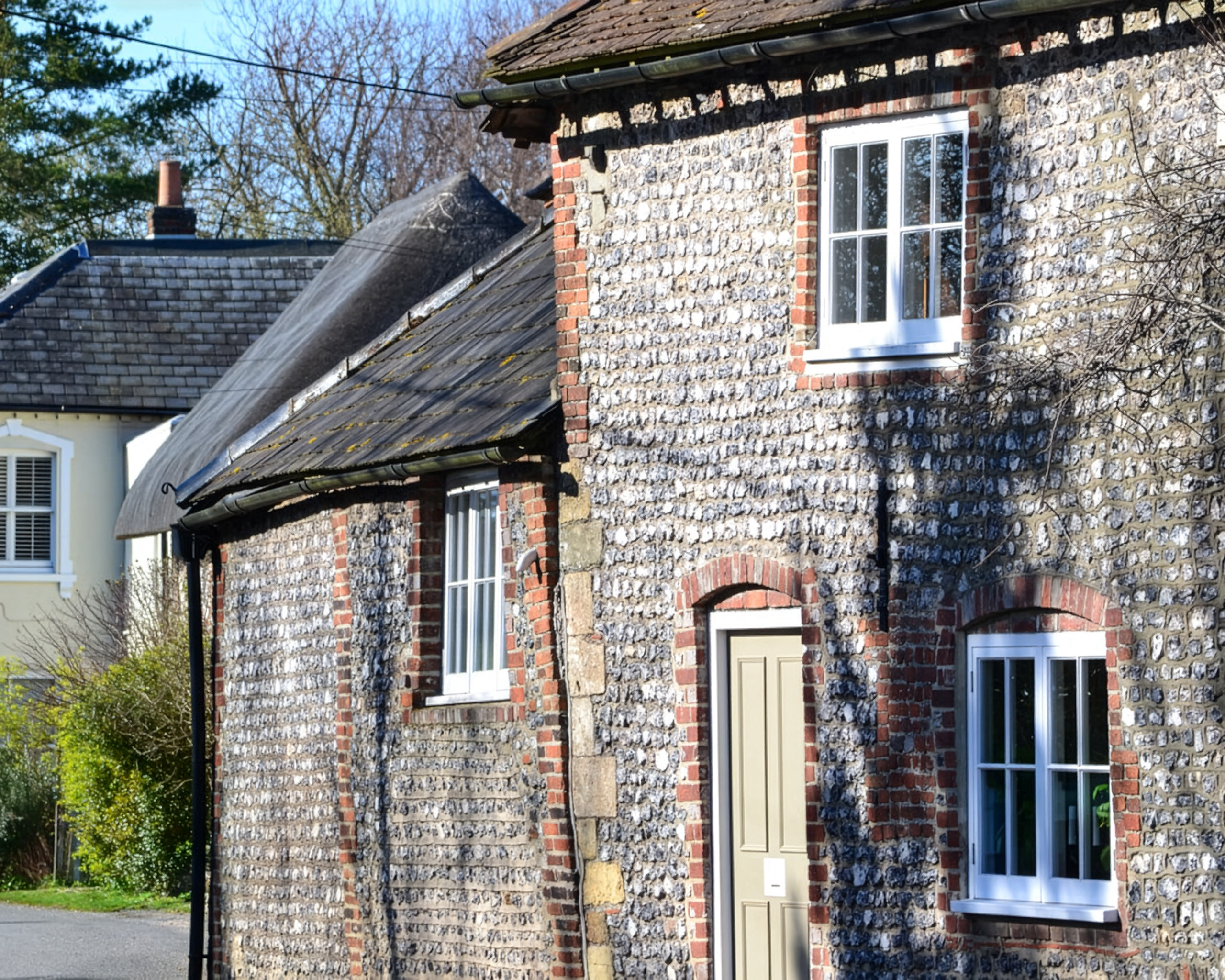
The craft expertise exists: Unlike many traditional skills, flint walling remains active in Sussex. The Flintman Company in Lewes maintains both historical techniques and contemporary applications. You’re not pioneering an untested approach but accessing established expertise adapted for modern performance requirements.
Original image by David Martin, CC BY-SA 2.0, Link, via Wikimedia Commons
History proves durability: Thousands of South Downs buildings built with these materials still stand after centuries. Your project wouldn’t be experimental but part of a proven tradition of building wisely with local geology. The material has weathered this specific climate, landscape, and weather patterns for generations.
The story resonates: If environmental performance matters to you, building with excavated chalk or local flint creates a powerful narrative about place, sustainability, and authentic response to site. This material honesty increasingly appeals to those who value both performance and meaning in architecture.
When These Materials Make Sense for Your Project
Chalk and flint aren’t appropriate for every project, but they excel in specific circumstances:
Strong candidates:
- New builds with significant excavation: If your project requires substantial ground work, using that excavated chalk transforms waste into resource.
- Sites on chalk geology: The South Downs, Chilterns, Dorset coast – anywhere the chalk formation surfaces.
- Valuing craftsmanship: If you appreciate the story of how things are made and the skill involved in making them well.
- Time flexibility: Rammed chalk construction and flint cladding require skilled work that can’t be rushed.
- Wanting exceptional thermal mass: If natural temperature moderation through the day and seasons appeals to you.
- Locations where vernacular materials aid planning: Conservation areas, National Park settings, or sites where demonstrating contextual sensitivity matters.
Less suitable scenarios:
- Very tight construction timescales: These materials require more time than standard construction.
- Minimal budgets: While material costs are low (especially for chalk), labour is intensive and skilled.
- Urban infill sites away from chalk geology: Importing chalk or flint negates environmental benefits.
- Extreme exposure without weather protection options: Very exposed coastal sites might require additional weather protection strategies.
Understanding the Investment
Rammed chalk has minimal material costs – you’re essentially building with processed excavation spoil mixed with lime – but labour is intensive. Flint cladding requires specialist craft skills that command premium rates. Both represent investments in durability and long-term performance rather than initial cost minimisation.
Consider the whole-life cost, not just capital outlay. While flint cladding costs roughly twice as much as brick per square metre, this translates to approximately 8-12% increase in overall project cost once you factor in all other building elements. But it may not need repointing for half a century, requires no painting, and no cladding replacement over its lifetime. Rammed chalk’s embodied carbon is a fraction of concrete’s or brick’s – increasingly important as regulations tighten and environmental performance becomes standard rather than exceptional.
What to Expect
If you’re interested in exploring these materials for your project, the process typically begins with understanding your site’s specific geology. Not all chalk is identical – different formations have different characteristics. We’d work with structural engineers experienced in earth building and potentially arrange pre-construction soil testing.
For flint cladding, we’d discuss the visual character you’re after – from rough field flint to finely knapped black faces – and work with specialist contractors to achieve it. The design needs to integrate these materials from the start; they’re not superficial finishes but fundamental to how the building works.
Conclusion: Closing the Loop

These materials aren’t merely history but active possibility. Chalk and flint solved problems centuries ago – thermal mass, durability, belonging to place, building with what’s beneath you. Those problems exist today, amplified: climate emergency, embodied carbon, disconnection from place, generic architecture that could exist anywhere.
Flint House shows the cladding is still available and can be used in new and refreshing ways. Chalk House shows the structure works. Both achieve modern performance standards. Both connect viscerally to their landscapes. This isn’t nostalgia or pastiche but ancient wisdom applied to contemporary challenges. It’s understanding why traditional techniques were used and translating that understanding to current needs.
We live on this geology. It’s literally beneath every South Downs site, under every chalk downland site from Dorset to Norfolk. Why import materials hundreds of miles when we could build with what we excavate? Why use cement when lime and chalk create breathable thermal mass? Why compromise on belonging to place when the place itself provides everything needed?
Mountain Fold Architecture is exploring these materials in contemporary practice. Not fake vernacular or heritage recreation, but as a genuine response to place through material. Contemporary buildings that understand their ground, that belong to their landscape not through superficial styling but through fundamental material honesty.
The chalk gets into your bones, Terry Pratchett wrote. It shapes character, defines identity, provides quiet defiant strength. If we’re building for a changing climate, for a future that demands we reconsider everything about how we make buildings, then perhaps we should start by looking down – at what’s been beneath us all along, patient and persistent as the landscape itself.
The materials that built Sussex for centuries can build its sustainable future. Time to close the loop between landscape and architecture. If you’re planning a project in the South Downs and want to explore whether chalk and flint could work for your specific site, get in touch. We can discuss your project’s geology, timeline, and aspirations – and whether these ancient materials might solve contemporary challenges.