
From Ancient Seabeds to Contemporary Architecture
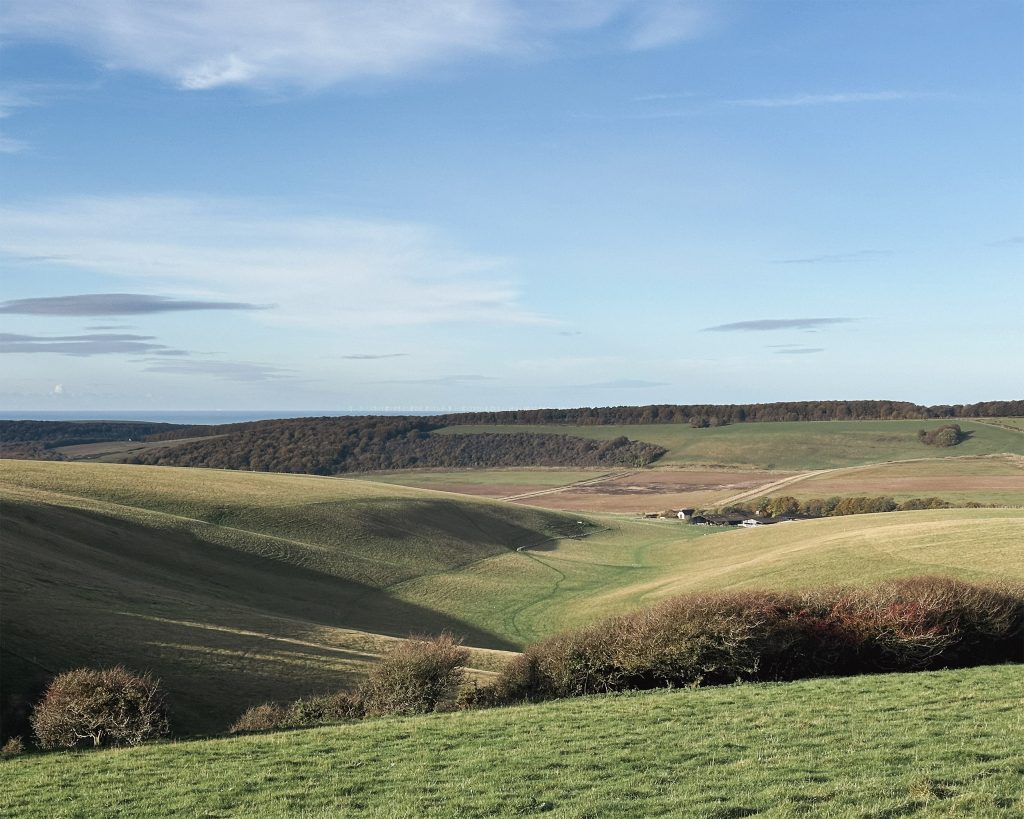
A couple of weeks ago I ran in the Beachy Head Marathon, a little over twenty-six miles through the South Downs on an October morning. Chalk paths worn white beneath my feet, black flint nodules glinting in the fields where the plough has turned the soil. The villages I passed through – Jevington, Alfriston, Litlington – are built from the same materials I ran across, the bones of the landscape itself.
Before improved transport links, before the mass production of building materials, vernacular architecture emerged directly from geology using readily available materials. Material and place were inseparable.
But these aren’t merely historical techniques, quaint relics for conservation projects. Two remarkable contemporary buildings prove that chalk and flint belong in 21st-century architecture as much as they did in the 11th. Flint House in Buckinghamshire uses flint as sophisticated cladding, while Chalk House in Dorset (which I’ll explore in Part 2) employs rammed chalk as structure. Both achieve modern performance standards while connecting viscerally to place.
This is architecture from the ground up – literally. Using what’s beneath the site, building with materials that have weathered this landscape for 100 million years. In this first part, I’ll explore the geological story of chalk and flint, and how contemporary architects are reimagining flint as a material for today.
The Geological Story: Deep Time Made Visible
In the Late Cretaceous period, between 100 and 66 million years ago, southern England lay beneath a shallow tropical sea. The water teemed with microscopic plankton and algae, their calcium-rich shells drifting endlessly down through warm currents. Layer upon layer, millennium upon millennium, these tiny organisms compressed into the sedimentary rock called chalk – soft calcium carbonate, porous and pale, containing the compressed memory of an ancient ocean.
The South Downs are the dramatic surface expression of this geology, a sweeping chalk ridge running from Winchester in the west to Eastbourne in the east. But the chalk formation itself extends further, a geological thread connecting Dorset to Norfolk, southern England to northern France. Where it breaks the surface, it has shaped everything – landscape, agriculture, architecture, even the character of those who live upon it.
Flint formed within this chalk through a remarkable process of geological alchemy. Silica from the remains of sponges and plankton percolated through the porous chalk in solution, then crystallised into hard nodules. This glassy stone – related to obsidian, jasper, and onyx – is found almost exclusively in chalk deposits, explaining why flint and chalk are geographically paired, inseparable companions in both geology and building tradition.
From Neolithic Tools to Norman Churches
Both materials have profoundly shaped human settlement of the South Downs. Flint, easily split to reveal sharp edges, enabled Neolithic peoples to create tools, weapons, and fire-striking.
As agriculture developed, chalk became equally vital. Burning chalk in kilns produced quicklime for mortar and agricultural fertiliser, while the land itself, though thin-soiled, supported sheep grazing that created the characteristic downland landscape. The famous lime kilns at Offham near Lewes transformed local chalk into the mortar that would bind flint walls across Sussex and Hampshire for centuries.
Walk through any South Downs village and you’ll see this material partnership everywhere: flint walls with limestone quoins, church towers of knapped flint in decorative patterns, cottages with lime-washed render over chalk rubble cores. The materials defined a vernacular architecture of remarkable durability – buildings that belonged so completely to their landscape they seemed to have grown rather than been built.
The Cultural Resonance
Terry Pratchett understood this when he made “the Chalk” central to many of his Discworld novels. His chalk downlands breed a particular kind of person: practical, grounded, quietly stubborn. “The chalk gets into your bones,” one character observes. Geology shapes identity.
Thomas Hardy made similar observations about his Wessex chalk country, that sense of ancient layers beneath everything, human history written in the landscape. Composer Frank Bridge, living near Cuckmere Haven, heard music in the downs and translated their rolling forms into “Enter Spring.” John Ireland’s “Downland Suite” does the same – cultural expressions of a landscape that has seeped into consciousness.
These materials carry meaning beyond their structural properties. When we build with chalk and flint, we’re not just solving technical problems but connecting to centuries of material tradition and cultural memory.
Why We Stopped
The break came in the mid-19th century with the arrival of Portland cement and railway transport. Suddenly mass-produced and standardised materials could be shipped anywhere, cement mortar eliminated the need for lime burning, and local traditions were steadily replaced. Within two generations, the skills of flint walling and chalk building nearly disappeared. We gained convenience and accessibility and lost understanding – forgetting not just how to work these materials but why they had worked so well.
Lime mortar manages moisture naturally through its excellent breathability, allowing walls to release and regulate water vapour and preventing trapped dampness. Thick chalk walls provide significant thermal mass that moderates internal temperature throughout the day. Flint is remarkably durable. These weren’t primitive solutions but sophisticated responses to enduring building challenges. Today, the same challenges remain, only now with higher performance demands and greater environmental urgency.
Flint Reimagined: From Medieval Craft to Contemporary Cladding
To understand flint as a building material, you must first understand it as a craft. Each nodule is unique – different size, shape, quality. Reading the stone, selecting the face to show, placing it for maximum stability and visual rhythm – this requires skill developed over years. A good flint waller doesn’t just stack stones but carefully arranges them, creating walls that are structurally sound and visually compelling.
Traditional Techniques
Traditional flint construction took several forms. The earliest technique used whole field flints – smooth, round nodules picked from ploughed fields – set in thick lime mortar with a rubble core between two skins. This created massive walls, excellent for thermal mass but requiring enormous quantities of material and mortar. As the craft developed, flints were increasingly worked to create more refined finishes.
Knapped flint – the signature Sussex technique – involves striking the nodule to split it open, revealing the glassy black interior face. These flat faces can be carefully coursed to create regular patterns. The best knapped flint shows subtle gradations of colour from black through grey to white, with the mortar joints forming crisp geometric lines.
Galleting presses small flint chips and shards into the wet mortar joints, originally for weatherproofing (reducing the exposed mortar surface) but creating a distinctive textured appearance. Walk through Lewes or Alfriston and you’ll see magnificent examples of galleted flint work, the mortar joints sparkling with embedded fragments.
Snapped flint shows the cleaved face but without the precise squaring of knapped work, creating a more textured, less formal appearance. Field flint uses unworked nodules, graded by size and carefully placed to create stable walls despite the irregular shapes. Each technique suited different building types and budgets, from humble cottages to grand church towers.
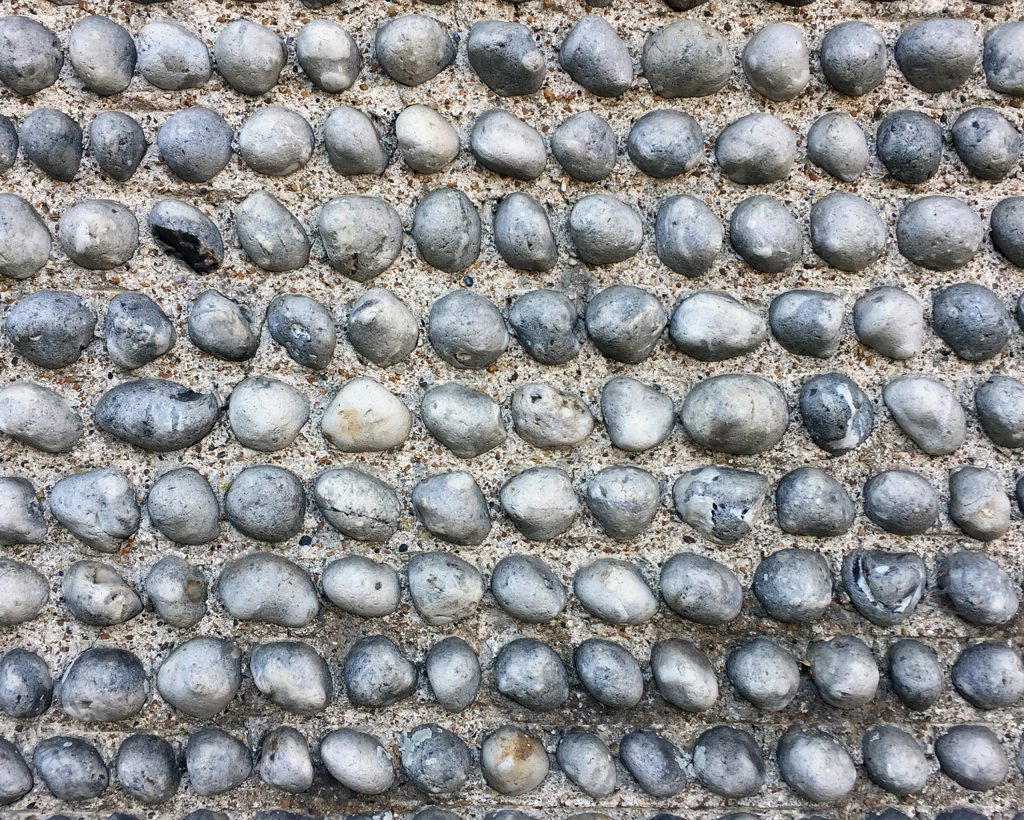
The craft required deep understanding: which flints would split cleanly, how to orient each stone for maximum strength, how much mortar to use, when to add galleting. Lime mortar was essential – it remains flexible as the building moves seasonally, breathes to manage moisture, and can be easily repaired or repointed. The partnership of hard flint and soft lime created walls that have stood for centuries, improving with age as the lime slowly weathers to reveal more of each nodule’s character.
Flint House: Contemporary Material Intelligence
When Lord Rothschild commissioned accommodation for visiting curators at Waddesdon Manor in Buckinghamshire, architects Skene Catling de la Peña conceived of the building as “geological extrusion,” as if the landscape itself had been compressed and lifted. The site sits on the same chalk band that runs beneath the South Downs, making flint the obvious – the inevitable – material choice.
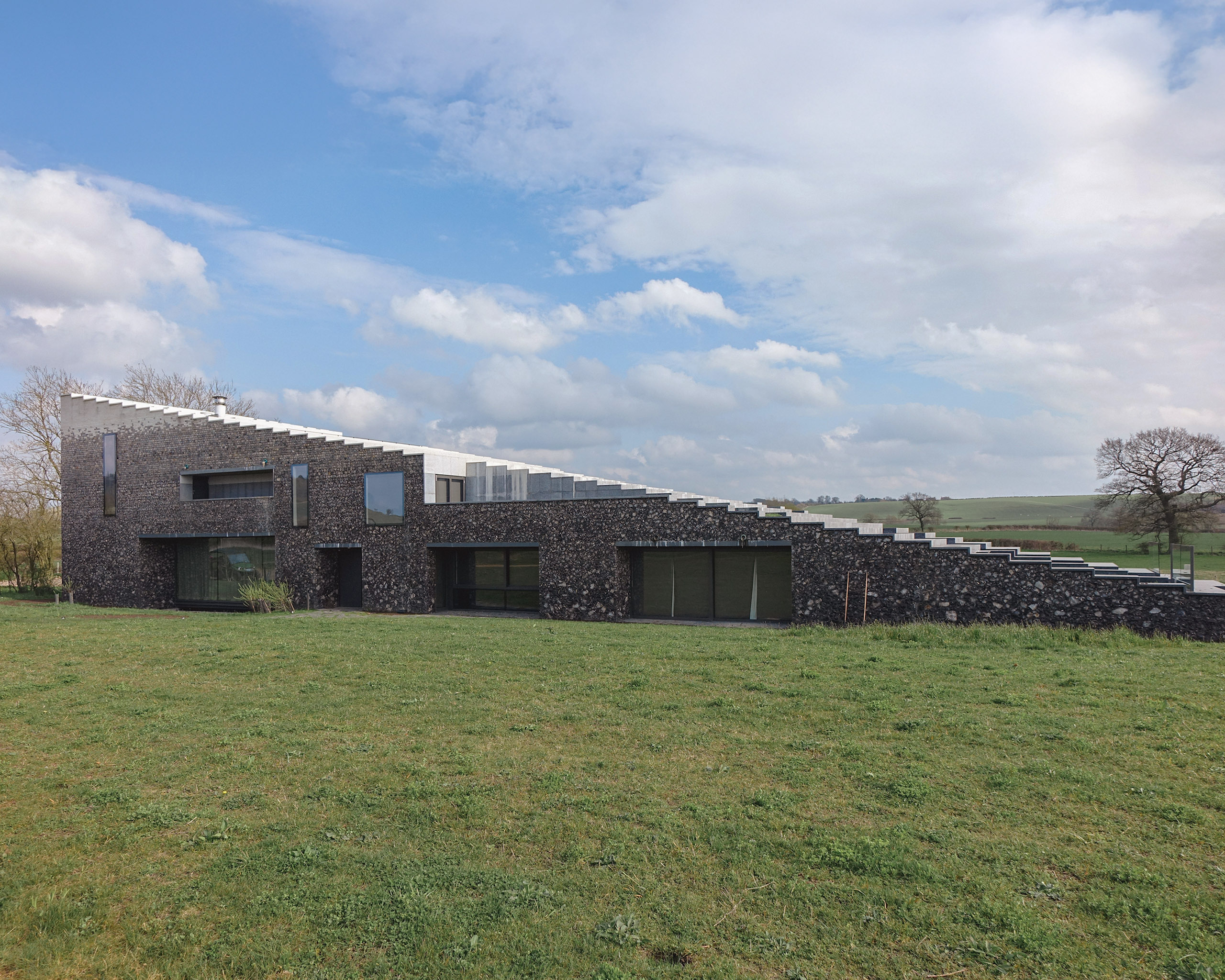
Original from Wikipedia (by FdeR1838 – Own work, CC BY-SA 4.0, link)
But this is emphatically not a pastiche of vernacular building. Flint House is strikingly contemporary, two wedge-shaped volumes rising at angles from the ground, one containing the main living spaces, the other a self-contained annexe. The structure is modern – cast concrete and blockwork frame achieving current thermal performance standards through insulated cavities. The flint is applied as sophisticated cladding, a rainscreen over high-performance insulation.
What makes this exceptional is the treatment of that flint cladding. Working with The Flintman Company, based in Lewes, East Sussex, the architects developed a graduated system of six strata. At the base: coarse black field flint with heavy galleting in black lime mortar, looking “ripped raw from the ground.” Moving upward, the flint becomes progressively finer and lighter through careful selection and knapping, transitioning through grey tones until the building culminates in pure white chalk blocks at the roof line. The building seems to evaporate into the sky, a geological stratification made architectural.
Inside, raw flint nodules line the entrance “river,” a compression of space showing the material in its found state before human intervention. This play between raw geology and refined craft, between earth and architecture, earned Flint House the RIBA House of the Year award in 2015.
Looking Ahead: Rammed Chalk
While flint has maintained a continuous if reduced tradition as cladding, chalk as structural material nearly disappeared – dismissed as too soft, too weak, too vulnerable to weather. Yet recent projects prove that rammed chalk can meet modern structural requirements while providing exceptional thermal mass and dramatically lower embodied carbon than conventional materials.
In Part 2 of this series, I’ll explore how contemporary architects are reviving rammed chalk construction, examine the remarkable Chalk House in Dorset, and provide practical guidance on using both chalk and flint in contemporary South Downs projects. I’ll look at how these ancient materials meet current Building Regulations, and when they make sense (and when they don’t).
The materials that built Sussex for centuries can build its sustainable future. Understanding their geology and traditional craft is the first step toward applying their material intelligence to contemporary challenges.
Continue to Part 2: Rammed Chalk Construction and Contemporary Practice →